Arizona Voters Approve Prop 318 Banning Transgender Student Athletes
Arizona voters have approved Proposition 318, a ballot measure that expands the state’s ban on transgender students participating in girls’ sports and restricts their access to school bathrooms and locker rooms. The measure passed with approximately 58% of the vote on Nov. 4, prompting immediate protests at the state Capitol where advocates criticized the campaign's reliance on financial spending over personal narratives.
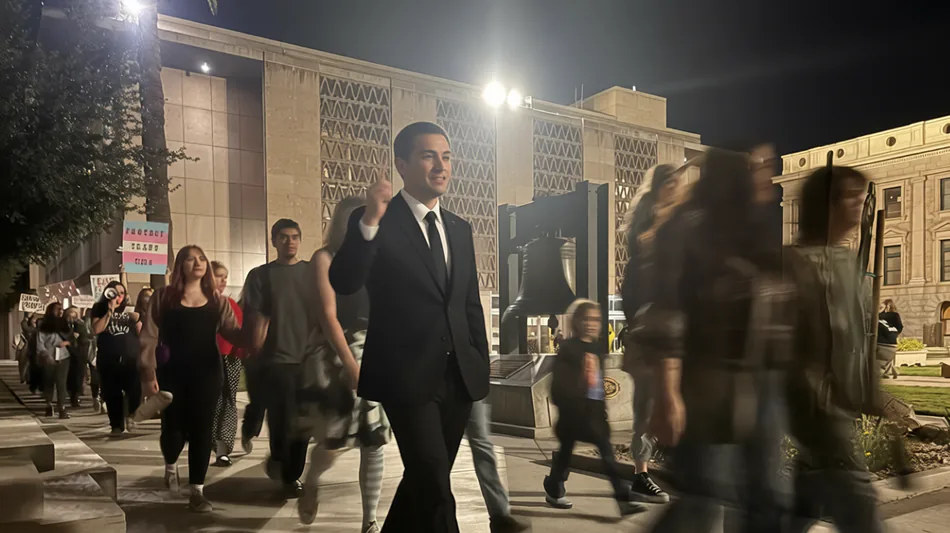
Arizonans gathered at the state Capitol on the evening of Nov. 4, chanting and holding signs in response to the passage of Proposition 318. The ballot measure, which expands the state’s ban on transgender students’ participation in girls’ sports and restricts their access to school bathrooms and locker rooms, was approved by approximately 58% of voters when The Associated Press called the race early that day.
The rally occurred just one day after the election results were finalized. Maria Teresa Mabry, co-founder and director of the Arizona Democracy Resource Center, expressed visible emotion while analyzing the factors that contributed to the measure's success. She pointed to a significant financial advantage held by supporters and a campaign strategy that marginalized transgender voices.
“There was a huge influx of money that came in to really amplify a message that this was about women and girls,” Mabry said. “This was actually about removal of trans folks from public spheres.”
Proposition 318 takes effect on Jan. 1, 2027. The measure originated in the Arizona House as House Concurrent Resolution 2003 and was introduced by Republican Rep. Selina Bliss of Prescott. It prohibits transgender students from playing on sports teams that do not align with their sex assigned at birth. Republican lawmakers sent the resolution directly to voters, bypassing Democratic Gov. Katie Hobbs, who had vetoed similar bills in 2023, 2024, and 2025.
Because the measure was approved by voters, it is now voter-protected, making it significantly more difficult for future legislatures to repeal. Arizona law already barred transgender girls from playing on girls’ sports teams; the new measure extends this ban to private athletic associations and adds restrictions on the use of locker rooms, bathrooms, and showers that align with a student’s gender identity.
Opponents argued that the measure violated the Arizona Constitution’s single-subject rule by combining regulations on student athletes with those on school restrooms. They also contended that the ballot title, “Protect Girls’ Sports in Arizona Act,” was misleading because it did not mention the impact on bathroom access for all students. Maricopa County Superior Court Judge Greg Como rejected these arguments in July, ruling that the measure could remain on the ballot.
Mabry stated that opponents’ messaging failed to gain traction in the final days before the election. She argued that the campaign did not center transgender people’s stories enough, which she described as a key element in countering what opponents called a dehumanizing message from supporters.
The main opposition campaign, run by the progressive group Will of the People, announced in October that it would spend $1 million fighting Proposition 318 and three other measures Republican lawmakers had sent to the ballot. Despite this spending, Mabry noted that the language of the measure had a chilling effect on legislative testimony.
State Sen. Lauren Kuby, a Democrat from Tempe, reported that some families were afraid to testify because they felt threatened by the political climate. She cited comments by Sen. John Kavanagh, a Republican from Fountain Hills and co-sponsor of the measure, who justified his support by dismissing transgender Arizonans as a small number of people.
“I heard from a number of constituents who said their children wanted to come and testify, but they felt threatened,” Kuby said. “The idea that people are afraid to come in because they know they are going to be mocked and treated with arrogance by a Senate chairman? Cowards.”
Mabry framed the measure as a tool for dividing people into those worthy of participating in civic life and those who are not. She emphasized the importance of building political spaces where transgender individuals can share how discrimination has affected their lives.
“Even in the ‘No’ campaign there was a hesitancy to talk about trans issues,” Mabry said. “We know when we talk about trans issues they actually poll significantly higher, especially when we get to tell our own stories.”
Mabry pointed to signs of growing transgender visibility and support in Arizona, citing large turnouts for recent mobilization events. These included the Trans Liberation March on Oct. 24 and a Party at the Polls on Oct. 28 in downtown Phoenix, which organizers called the first transgender march in the state’s history.
“We had folks come from Winslow, we had folks from Yuma, we had folks from Sierra Vista come to Phoenix,” Mabry said. “We are a voting bloc.”
The passage of Proposition 318 coincided with other significant political shifts in Arizona on Election Day. The same night, Arizona Democrats flipped a congressional seat, and voters rejected a Republican-backed voter ID measure.
Arizona was one of five states with measures on the ballot targeting transgender youth in the 2026 elections, alongside Washington, Colorado, Nebraska, and Missouri. These measures called for restrictions on transgender youth access to healthcare, sports, and school facilities.
W.Wouters--JdB