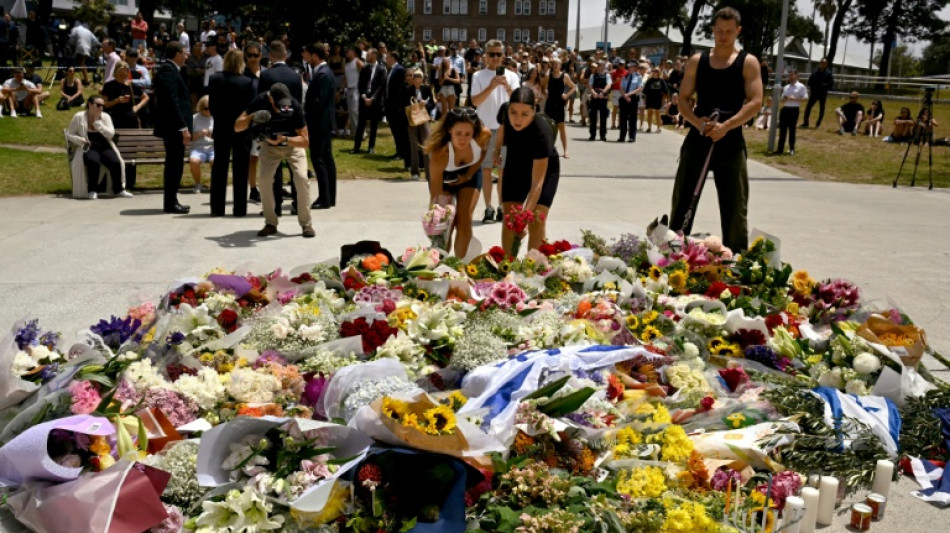
Bondi Beach attack survivor tells of 'trauma' of online AI images / Photo: Saeed KHAN - AFP
A Jewish lawyer wounded in a mass shooting at Australia's Bondi Beach discovered that AI-generated images depicting him as a "crisis actor" were proliferating online as he was going into surgery, a royal commission inquiry heard Monday.
Arsen Ostrovsky, a Jewish community leader, said a selfie image he had sent to a friend in the aftermath of the antisemitic attack was quickly distorted by AI online to make it appear as if his injuries had been faked.
His story emerged in hearings of the federal royal commission, the highest level of public inquiry, which was formed after the December 14 attack, Australia's deadliest in decades.
During the assault, father-son duo Sajid and Naveed Akram are accused of opening fire on Jewish families celebrating Hanukkah at the country's most famous beach, killing 15 people.
Public hearings -- tasked with probing the factors leading to Australia's deadliest mass shooting -- have started to receive testimony about the role social media plays in the spread of antisemitism.
"It has become increasingly apparent that the online environment and social media platforms in particular are perhaps the most significant factor for the spread of antisemitism," said assisting counsel Richard Lancaster.
Ostrovsky, head of the Australia/Israel and Jewish Affairs Council in Sydney, said his selfie started "spreading like wildfire" after being posted online by his friend.
The image depicted him lying on the ground with his head bloodied.
But within hours, AI-generated images were created, with one showing him laughing as a make-up artist touched up the blood on his face.
- 'Like wildfire' -
Social media users said the image was of a crisis actor, someone supposedly hired to secretly stage deadly events to advance political agendas -- a persistent narrative among conspiracy theorists.
Ostrovsky said he discovered the disinformation spreading while he was in hospital two days after the attack.
"I was literally being prepped to go into surgery when I first found out online that was happening," he said.
Ostrovsky said other deepfake images appeared to show him in hospital with his bandages removed, or holding an Academy Award trophy, many of which are still online today.
Several fact-checking organisations, including AFP's digital verification team, have debunked these images.
"These images started spreading like wildfire... and then the media started contacting me for a response."
Ostrovsky said he had previously experienced antisemitism online, but "after December it became impossible for me to keep up, it essentially became a relentless tsunami of Jew hatred online", he said.
Meta responded quickly to remove the false content, but Ostrovsky said he had not had a response from X or YouTube.
"The cumulative nature of it is overwhelming... it tries to completely erase my experience and my trauma," Ostrovsky said.
The commission will also look at social media's "gaps and weaknesses in the detection and removal of hateful content in a timely manner", Lancaster said.
Public hearings will continue through July.
C.Bertrand--JdB