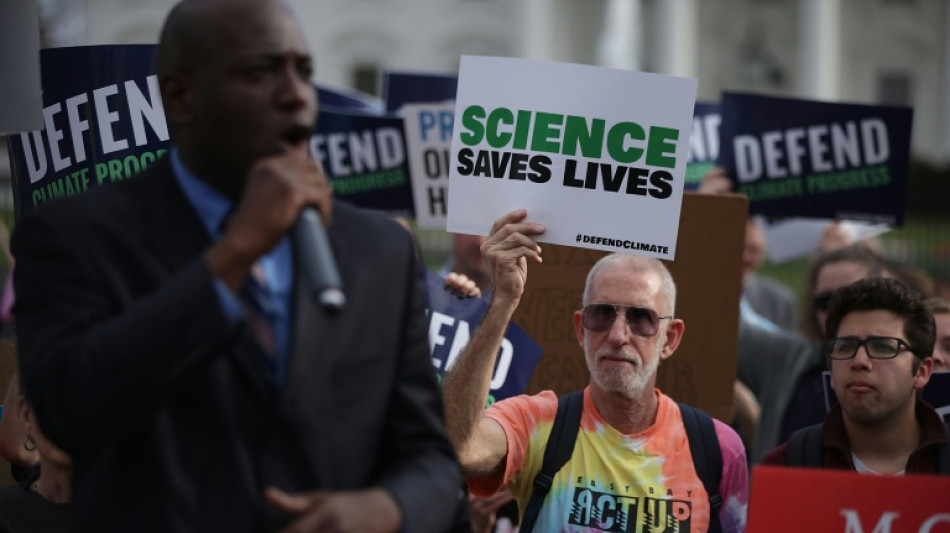
Trump climate pushback spurs courtroom battles, report says / Photo: ALEX WONG - GETTY IMAGES NORTH AMERICA/AFP
President Donald Trump's rollback of federal regulations has spurred an unprecedented wave of lawsuits in defence of climate protections, a new global analysis of litigation trends showed on Thursday.
The trend was most prevalent in the United States, but similar legal battles over the dismantling of climate policies were playing out globally at a scale "without precedent", the report said.
"Between last year and this year, the climate movement has responded to that pushback," report co-author Joana Setzer from the Grantham Research Institute at the London School of Economics told AFP.
"What we see is an increase in litigation that is challenging de-regulation".
These "protective" cases are brought not to pursue new climate goals but to seek to keep hard-won policies or pledges in place, she said.
One in five new climate cases in the United States in 2025 fell into this class of legal action, the report said, a sharp rise from Trump's first term in office.
"The legal landscape of protective climate litigation in the US is evolving rapidly and will be a critical area to track through the remainder of 2026," the report said.
But a "significant number" of similar cases were filed outside the United States in 2025, the report said, including in Europe and Brazil.
- AI in crosshairs -
Courtrooms have increasingly become a battleground in the fight for stronger climate action in recent years.
Activists have sued fossil fuel companies and gone to The Hague in an effort to hold governments accountable for their greenhouse gas emissions.
Last year, the International Court of Justice ruled that states were obliged to tackle climate change under international law in a landmark ruling.
On Thursday, a French court will rule on whether oil and gas giant TotalEnergies breached its legal duty to address environmental risks in a closely watched climate case.
More than 3,600 climate cases have been filed over the past 40 years -- the overwhelming majority of them in the United States.
But most cases have been lodged since 2015, the year of the Paris Agreement on climate change.
Climate litigation is expanding and "maturing", the report said.
Grenada, Guatemala, Kazakhstan, Malaysia, Singapore and Zambia recorded their first climate cases in 2025, it added.
But opponents have also used the law to thwart climate action. The report underscored the "increasing scale, coordination and institutional depth" of these efforts.
It cited the proposed "Stop the Climate Shakedowns Act" in the United States, which seeks to shield polluting companies from legal action.
This "concerning new development" could restrain access to justice and had inspired similar policies in New Zealand and Germany, said Setzer.
"It suggests others are paying attention... It's the kind of idea that travels," said Setzer.
The report also warned that lawsuits against AI data centres were growing, particularly in Ireland where these facilities require a large share of national energy demand.
This was "the next area that is set to grow massively in the US and across the world, as people challenge their climate impacts in the courts," said report co-author Catherine Higham.
The report identified carbon dioxide removal and storage projects and plastic manufacturing companies as other emerging targets for future litigation.
S.Vandenberghe--JdB