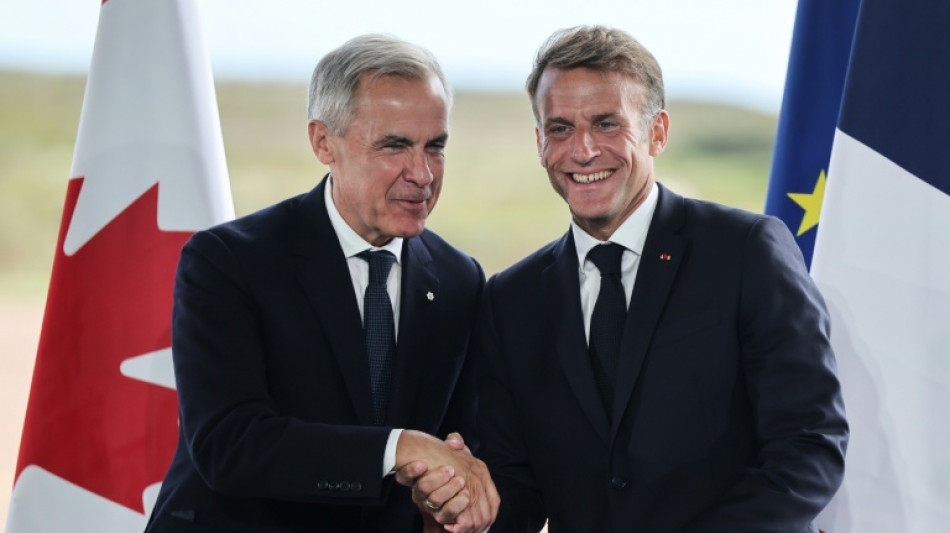
France's Macron, Canada's Carney announce closer ties / Photo: Ludovic MARIN - AFP
French President Emmanuel Macron and Canada's Prime Minister Mark Carney announced closer ties Sunday, speaking from France's tiny territory of Saint Pierre and Miquelon, just off Canada's Atlantic coast.
The leaders' meeting came at a time when both countries are experiencing strained relations with the United States.
"We both believe that our countries are two great, independent nations who want to remain so," said Macron at their joint news conference.
Carney said the moment had come to tighten bonds with France and the European Union, following up on a successful visit to Brussels, when the EU offered Canada "associate member" status.
Macron said the two countries would work together for closer ties on fishing, security and energy.
Carney proposed that France, Canada, the United States and China work together on artificial intelligence.
Earlier Sunday, Macron was waiting for Carney, the first Canadian prime minister to visit the territory, when he stepped off the plane.
The two leaders greeted each other with a warm handshake and a long embrace in the bright sunshine.
"In a world in crisis, our friendship is a strength," Macron posted on X, above a video of him welcoming Carney.
"Together, we affirm our sovereignty, our freedom to decide and our willingness to build a future of peace and prosperity," he added.
Carney also posted a video of their greeting on his X account. Posting in English and in French, he added: "Good to see you, my friend."
- Tensions with US -
The trip carries significant symbolic resonance.
The archipelago is France's only remaining possession in North America, a vestige of the vast territories Paris once controlled in what is now Canada and the United States.
Macron argues that US President Donald Trump's second mandate has reinforced the case he has promoted that Europe needs to become more sovereign, especially on security.
Carney, caught up in an intensifying dispute with Trump -- who has even threatened to annex Canada -- has welcomed a proposal for his country to become the European Union's first "associate member".
He has described his nation as "the most European of non-European countries".
Trump's repeated remarks about making Canada the 51st US state have been strongly rejected by Ottawa.
On Monday, Trump posted an image to social media with a map of North America in which Canada, Greenland and Mexico, much of central America and the Caribbean, as well as Iceland, were coloured in with the US flag.
The image also encompassed several French overseas territories, such as Guadeloupe, Martinique -- and Saint Pierre and Miquelon.
But the territory is French, Macron reaffirmed on his arrival in the territory late Saturday, dismissing "strange ideas" on the subject.
- 'Common values' -
The joint visit was to underscore that Canada and France share "the same values of freedom, democracy, the rule of law and respect for the sovereignty of nations", the French president's office said ahead of the meeting.
That was certainly the message at Sunday's joint news conference.
"We both believe in democracy, the rule of law, respect for free and fair trade, the science on which our decisions are based, and the stragetic autonomy that we defend," said Macron.
"And this is what very deeply unites Canada and France, Canada and the European Union," he added.
Carney said: "The time has come to tighten our links between Canada and France, between Canada and the European Union -- links based on the values we share."
Macron's three-day visit to the French territory, an archipelago of fewer than 6,000 people a short distance from Newfoundland, is the first by a French president in more than a decade.
J.F.Rauw--JdB