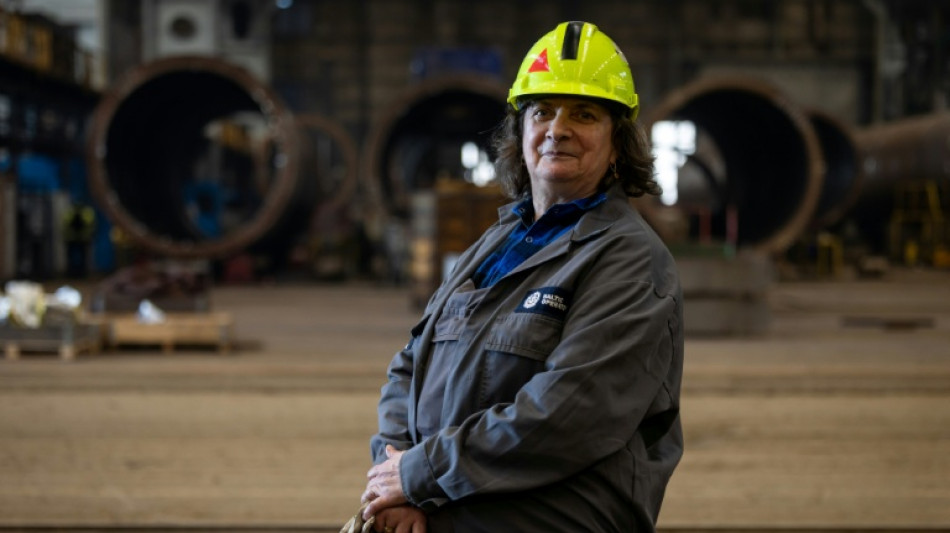
Women rule the roost atop the Gdansk shipyard cranes / Photo: Wojtek RADWANSKI - AFP
For the past 30 years, Halina Krauze has sat atop a 15-metre (49-foot) crane surveying the Gdansk shipyard, the birthplace of the Solidarnosc trade union.
For eight hours, the 65-year-old displaces tonnes of steel that will become ship hulls and wind turbine components.
She is one of dozens of crane operators at the huge yard, the largest in Central Europe.
Far below the cabin, hundreds of workers in overalls, helmets and protective goggles are busy at work.
The noise is constant, sparks fly and the air is full of welding fumes.
Around 70 percent of Poland's construction site crane operators are women, a tradition inherited from the Communist era.
In the Soviet period, "women had to be employed somewhere and since they couldn't do hard labour, they were integrated into other professions", explained Agnieszka Pyrzanowska, spokeswoman for the state-owned Baltic Industrial Group, which now operates part of the shipyard.
"Entire families worked for the same company."
Indeed, Krauze met her husband Stanislaw at the yard and today they work in the same unit.
"He's up there!" she exclaimed, waving energetically at another crane cabin in the sky.
- Remembering a legend -
Krauze joined what was then called the Vladimir Lenin shipyard in 1983, first in a coal-fired boiler room and later operating a crane.
"In the beginning, it was a shipyard. We built a good dozen ships a year. Now we build dozens of wind turbine towers. It's quite different," she said.
She is proud to have worked on the same crane as Anna Walentynowicz, one of the founders of Solidarnosc.
It was Walentynowicz's dismissal in 1980 that triggered the huge shipyard strike and the creation of the first free trade union in the Communist bloc.
Walentynowicz was "a kind of legend, especially among the older generation", Krauze remembered.
With a steady hand, she manoeuvred a huge wind turbine section, five metres in diameter, across the yard.
"There are people below you so you have to be careful nothing happens to them," said Lesia Kovalchuk, a 48-year-old Ukrainian colleague.
Kovalchuk was a crane operator in Ukraine for 15 years before moving to Poland as a refugee when Russia invaded her country in 2022.
Now she teaches young apprentices on Gdansk construction sites.
"In Ukraine, it's completely normal for women to operate cranes. No-one is surprised," she shrugged.
Both women agreed their male colleagues preferred to work with them than with other men.
"Women are calmer and more precise," Hrauze opined.
"Blokes try to get things done as fast as they can. Girls are all about finesse," Kovalchuk grinned.
One thing has changed though, since the Communist era.
At those days, women workers used to receive small gifts on International Women's Day -- "those famous tights, chocolates, carnations...", Krauze recalled.
"There's nothing any more," she said ruefully. "The unions have all forgotten about women."
E.Heinen--JdB