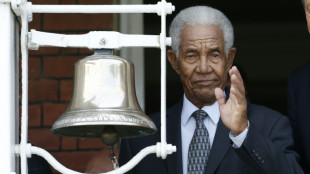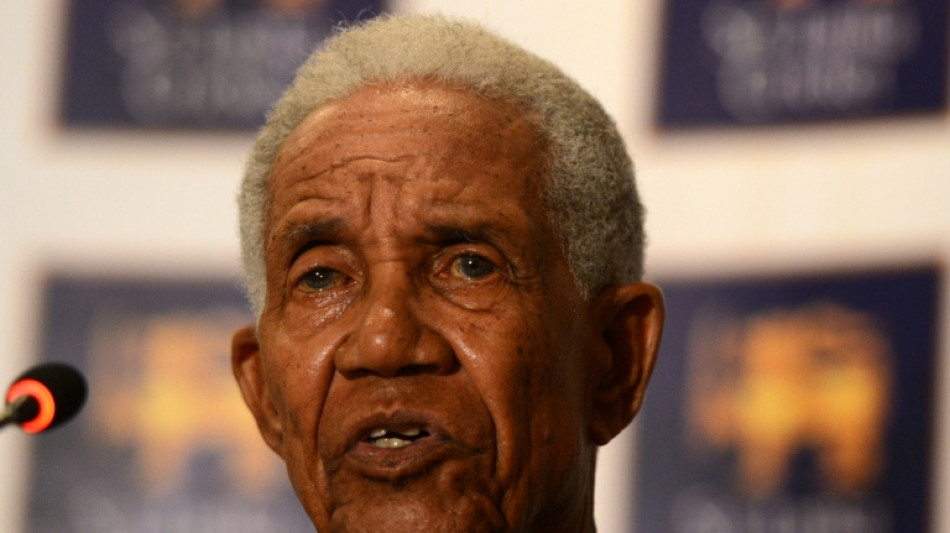
Garry Sobers, towering West Indies cricket all-rounder, dies at 89 / Photo: LAKRUWAN WANNIARACHCHI - AFP
Cricket in the 20th century was littered with great players, but by universal consent two stand head and shoulders above the rest - Australian batsman Donald Bradman and West Indian all-rounder Garry Sobers, who has died aged 89.
"A great innings has come to an end. In our hearts, now and forever, Sir Garfield Sobers," West Indies Cricket posted on social media on Friday.
In a poll of 100 cricket experts in 1999, both Bradman and Sobers were chosen in Wisden's Five Cricketers of the 20th Century with the West Indian all-rounder garnering 90 votes.
Bradman had an extraordinary 100 votes and yet before his own death in 2001, the Don paid the ultimate tribute to Sobers.
"He is, in my opinion, the greatest cricketer of all time," said the Don.
That tribute is based not just on the statistics or on style -- of which Sobers had plenty -- but on the breathtaking breadth of his cricketing ability.
As a batsman Sobers scored 8,032 runs in his 93 Tests at an average of 57.78, numbers that on their own that would guarantee him a place in any pantheon.
On top of that, Sobers was a bowler, who took 235 wickets at 34.03 runs each.
Sometimes he would open with fast left-arm but, if the pitch was breaking up, he would switch to the left-arm spin -- orthodox or wrist -- that first brought him to the attention of the West Indian selectors as a teenager.
He was also a lightning fielder, taking 109 Test catches, often at slip but, as captain, he would place himself in the danger zone at short-leg when he brought off-spinner Lance Gibbs into the attack.
"The bloke could do just about anything on a cricket field except umpire," Australian all-rounder Alan Davidson told The Cricket Monthly on the occasion of Sobers' 80th birthday in 2016.
"He was a complete cricketer, magnificent fielder, bowled all types of bowling, and when in form, he absolutely decimated great bowling attacks.
"You could not set a field to him because he just had that innate ability to be able to score runs whenever he wanted to."
- Early promise -
Garfield St Aubrun Sobers, who was known as both Gary and Garry, was born in Bridgetown, Barbados on July 28, 1936, the fifth of six children.
He was just six when his father Shamont, a merchant seaman, was killed when his ship CNS Lady Hawkins was struck by two torpedoes from a German U-boat off the North Carolina coast.
Sobers showed immense early promise in several sports. He made his debut for Barbados against the Indian tourists as a spinner in January 1953 aged just 16.
He played against the MCC tourists a year later and, after just two first-class games, was selected as a replacement for the ill Alf Valentine for a Test debut against England at Sabina Park in March 1954.
The tourists won by nine wickets but Sobers made an early impression, removing Trevor Bailey in his first over, and taking 4-75 in the tourist's first innings.
- Record breaker -
Four years later he shifted himself on to another plane against Pakistan in Kingston, breaking a world record in the process.
Since 1938, Len Hutton's 364 against Australia at the Oval had stood as the highest individual score in Test cricket. Sobers, in his maiden Test century, made 365 not out, setting a record that would last until another West Indian Brian Lara made 375 against England in 1994.
In the tied Test in Brisbane in 1960-61, he scored a blistering 132 which set the tone for a memorable series.
"It was absolutely one of the greatest innings I have ever seen in my life," said Davidson.
"He didn't just beat the field. He split the field. His placement was just incredible."
Sobers succeeded Frank Worrell as West Indies captain for the 1964-65 series at home to Australia and led the hosts to their first ever series win against the Aussies.
Results were mixed under his captaincy, which lasted until 1972 when he handed over to Rohan Kanhai, but with Sobers' hand on the tiller, West Indies cricket continued to develop and evolve into the dominant force of the late 1970s and 1980s.
As Sobers aged so his influence on the field waned but he still stroked 254 for the Rest of the World at the MCG in 1972 in what Bradman described as "probably the greatest exhibition of batting ever seen in Australia".
Outside the international arena, Sobers helped South Australia win the Sheffield Shield and played for Nottinghamshire in England's county championship.
In 1968, while facing Glamorgan bowler Malcolm Nash, he became the first player to hit six sixes in one over - a feat only equalled once since in first-class cricket by Indian all-rounder Ravi Shastri in 1985.
Sobers retired from Test cricket in 1974 and was knighted a year later.
The International Cricket Council honoured him in 2004 when with the Sir Garfield Sobers Trophy for the annual world player of the year but it is the testament of Bradman which will mark him as one of the greatest cricketers.
P.Renard--JdB