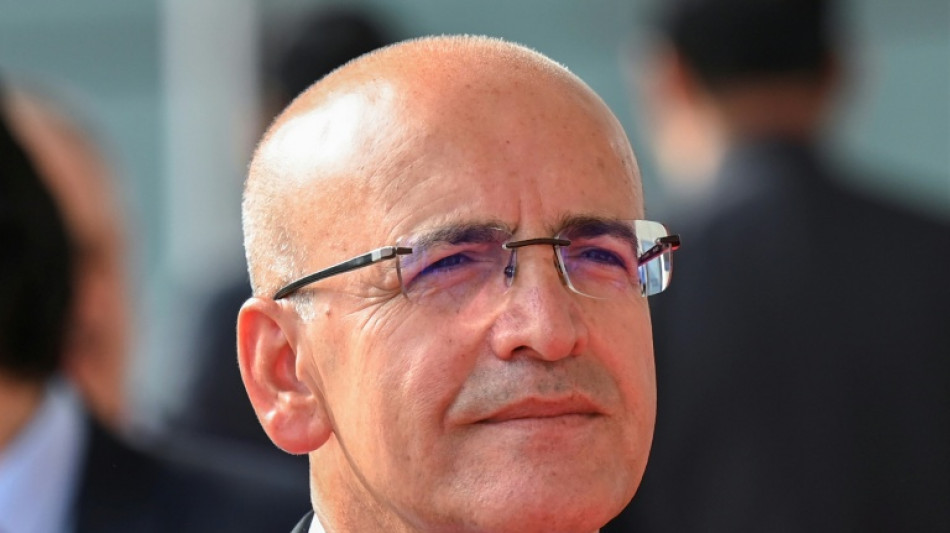
All who profited from fund scandal 'identified': Turkish minister / Photo: Punit PARANJPE - AFP/File
Everyone who profited from the sprawling multi-billion dollar investment fund scandal gripping Turkey has been identified, Finance Minister Mehmet Simsek said on Tuesday, expressing confidence the markets would emerge stronger from the controversy.
The scandal hit the headlines just over a month ago, with prosecutors looking into allegations of widespread market manipulation affecting the savings of some 455,000 individual investors.
It has raised uncomfortable questions about who might have profited, putting pressure on President Recep Tayyip Erdogan's ruling AKP, which has lost one senior official, an ex-minister who resigned following allegations about her investment activities.
On Monday, the head of Turkey's SPK capital markets regulator was sacked and the deputy finance minister resigned, although neither departure was officially tied to the crisis.
"Everyone who profited from market-disrupting activities has been identified," Simsek told HaberTurk TV and HT Bloomberg, without indicating how many people were involved, and whether they had been detained or questioned.
"Those who made real gains of 10 million lira ($202,000) or more will be approached. If there is no voluntary return, the justice ministry will initiate the relevant legal procedures," he said.
"Then recovering assets that were unlawfully transferred from the funds to individuals and companies becomes extremely important. Those who colluded will be pursued through their personal assets."
So far, 85 people have been jailed pending trial in the affair, the justice ministry has said -- a figure that has not changed since October 4.
The crisis has angered the political spectrum with the main opposition Yeni party raising questions about whether two ministers had profited through investments in the suspect funds.
Both ministers denied the allegations.
- 'World's largest casino' -
"$20 billion is not a small amount of money," Tuncer Bakirhan, co-chair of the pro-Kurdish DEM party, said on Tuesday, describing the affair as "one of the biggest scams in history".
"Turkey's economy has been turned into one of the world's largest casinos."
On Monday, SPK chief Mahmut Sutcu was removed by presidential decree after barely five months in office, just days after prosecutors began investigating his predecessor.
And on the same day, Simsek's deputy Osman Celik resigned, state news agency Anadolu said.
The decision came around two weeks after his son-in-law, Iskender Balci, was jailed pending trial in the fund scandal.
Until August 31, Balci served on the board of Turkish shipbuilding firm Ozata Denizcilik.
That company came up on September 26 when a Yeni lawmaker sought clarification over claims senior AKP official Fatma Betul Sayan Kaya and her husband had made significant profits through transactions involving its shares which they allegedly offloaded before the scandal broke.
She resigned later that day although it remains unclear whether she has faced any legal measures.
- 'Markets will be much healthier' -
The scandal emerged when several funds were unable to satisfy redemption demands.
Regulators put into liquidation seven firms that manage 131 investment funds with assets reportedly worth some $17 billion.
"Of these 131 funds, 66 have been completely liquidated," Simsek said, adding that the liquidation of A1 Capital, Pardus and Bulls -- three of the portfolio management companies -- was also completed.
Turkey would "significantly increase sanctions relating to manipulation and other market-disrupting actions" and would "strengthen supervision and oversight" as well as addressing any "gaps in the legislation", he added.
Last week, ratings agency MSCI expressed concerns over market transparency.
It pointed to concerns over "possible coordinated trading" and put Turkey on notice it could reassess the country's emerging-market status if there was no sign of concrete improvements by June 2027.
Simsek said Turkey had already started "addressing the issues they identified as problematic", saying the fact the MSCI had given them time was "important".
"Although the whole process was somewhat challenging... everyone with common sense says the Turkish capital markets will be much healthier," he said.
T.Moens--JdB