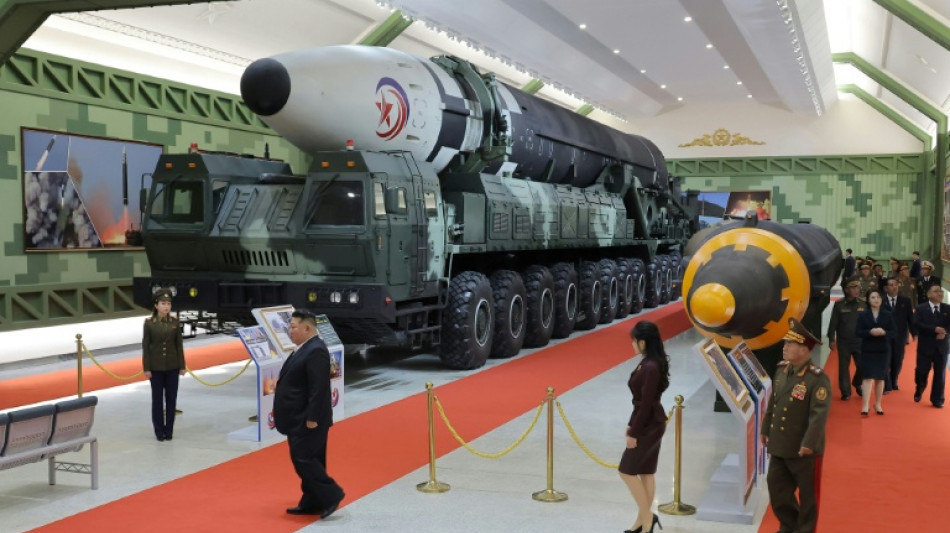
Hypersonic weapons highlight arms race on the Korean peninsula / Photo: Handout - KCNA/AFP
South Korea test-fired its first homegrown hypersonic missile last week, days after the North announced the AI-assisted launch of an intermediate-range hypersonic missile.
AFP looks at what we know about the two Koreas' hypersonic weapons and what they could mean for security on the peninsula.
What are hypersonic weapons?
Hypersonics are defined as being able to travel at velocities of at least five times the speed of sound -- Mach 5, or more than 6,100 kilometres (3,800 miles) per hour.
By cutting flight times, they also reduce the opportunity to respond.
They can be capable of carrying conventional or nuclear warheads, depending on the design, and have the potential to alter the strategic balance.
Hypersonic glide vehicles, like those tested by South Korea, are launched into the upper atmosphere by rocket boosters or ballistic missiles before gliding towards their targets.
Why are they hard to intercept?
In addition to their sheer speed, hypersonic missiles can manoeuvre in mid-flight.
Their ability to weave, dip and change course as they descend towards their targets makes them harder to track and intercept than conventional ballistic missiles.
Existing missile defence systems are "better equipped to intercept conventional ballistic and cruise missiles, while hypersonic weapons -- along with drones for different reasons -- remain particularly challenging threats", Hong Sung-pyo, senior researcher at the Seoul-based Korea Institute for Military Affairs, told AFP.
That makes them harder for ground-based radar systems to detect until they are closer to their targets.
What do we know about North Korea's latest launch?
North Korean leader Kim Jong Un oversaw the launch of a hypersonic missile that allegedly used artificial intelligence, state media reported this month.
Pyongyang has said there was "no way to avoid" the missile that was "capable of changing its flight orbit at a low altitude".
It also said that the missile's "wave-like trajectory mode" left South Korea and Japan unable to track it effectively.
Hong Min of the Korea Institute for National Unification told AFP the launch was "more than a display of individual weapons, but a demonstration of an entire range of missile systems".
"It sends a signal that North Korea has weapons capable of evading interception across different ranges," he said.
But the nuclear-armed North is still believed to remain relatively weak in the critical technology needed to manoeuvre hypersonic missiles in the final stages of flight while maintaining strike accuracy, said the Korea Institute for Military Affairs' Hong Sung-pyo.
"My understanding is that North Korea is now conducting test launches aimed at perfecting that capability, with technological assistance from Russia," he said.
What about the South Korean launch?
South Korea test-fired its first homegrown hypersonic missile last week, calling it a "key strategic asset capable of changing the course of the battlefield".
The test assessed heat-resistant materials, guidance and control systems, and the weapon's ability to manoeuvre at low altitudes at hypersonic speeds.
Its "unpredictable flight trajectories and overwhelming speed" could enable strikes on key strategic targets and provide a new deterrence capability on the Korean Peninsula, the presidential Blue House said.
The decision for Seoul to publicly disclose the test was also a political one, said Jung Heon-joo, a public policy professor at Yonsei University in Seoul.
"Possessing this hypersonic technology could signal to potential adversaries that South Korea has a range of weapons options and that attacking it would not be easy," he told AFP.
There were "multiple audiences (for the test launch) -- North Korea, the South Korean public and neighbouring countries", Jung said.
What does it mean for the Korean peninsula and Asia?
North Korea also fired multiple ballistic missiles off its east coast on Monday, with experts saying the mixed launches may have been intended to complicate the ability of South Korean and US defence systems to respond.
"The purpose of mixing different types of ballistic missiles is to neutralise South Korean and US missile defence systems," said Yang Moo-jin, former president of the University of North Korean Studies in Seoul, adding that the launches appeared focused on operational training rather than testing new weapons.
The two Koreas' pursuit of hypersonic weapons could further fuel an arms race on the peninsula, while their speed and manoeuvrability could make detection and interception harder, with implications for US and Japanese defences, analysts say.
"The continued development of advanced weapons systems by both Koreas could intensify the arms race and further entrench the 'two hostile states' framework," Yang said.
K.Laurent--JdB