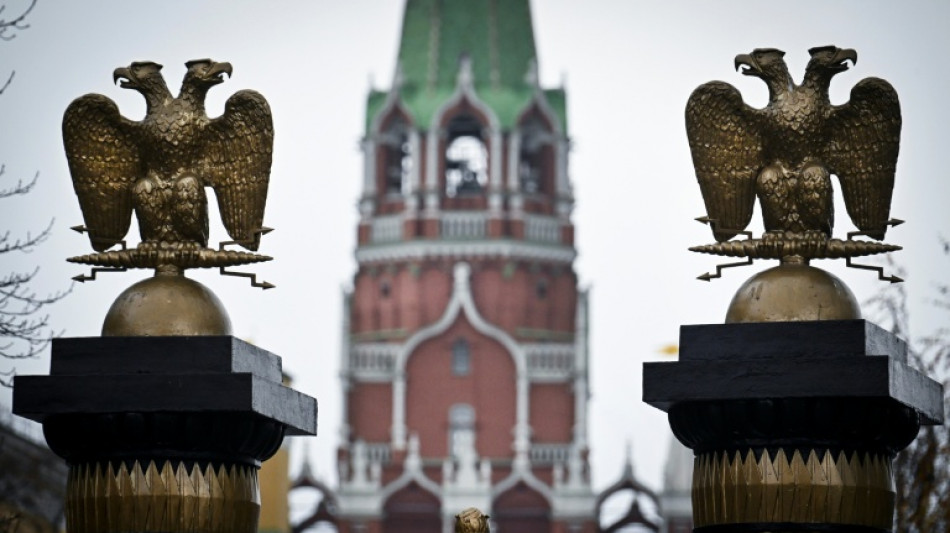
Former Russian insider says fear pushed elites to embrace Putin war / Photo: Alexander NEMENOV - AFP
Fear and distrust took hold in Moscow soon after Vladimir Putin invaded Ukraine in 2022.
Some officials and businesspeople started removing their smartwatches ahead of sensitive meetings, fearing possible surveillance or eavesdropping by security services, or leaving their cell phones in briefcases.
"The level of paranoia people are forced to live under is such that they are essentially afraid even to think -- let alone to speak," Alexandra Prokopenko, a former Russian central bank official, said in an interview in Paris.
"It's fear of an absolutely paranoid, Stalinist kind."
Prokopenko, a former insider and the author of a recent book about the Russian elites, said some officials resorted to unorthodox methods to protect themselves against listening devices.
One young deputy minister was so afraid of surveillance that he sat on his phone during a meeting in a chic cafe in 2022.
When it rang, he blushed -- the muffled ringtone came from under his backside.
He pulled out the iPhone, glanced at the screen, muttered, "In a meeting," silenced the device and sat back on it again, according to Prokopenko's book, whose English-language edition will be published later this year.
"From Sovereigns to Servants. How the War Against Ukraine Reshaped Russia's Elite" is based on in-depth interviews with Russian officials and businesspeople, and examines how elites embraced and enabled Putin's war despite their initial shock.
- 'Not an idiot' -
Prokopenko, 40, served as an adviser to the first deputy chairman of the central bank before the invasion.
Before that, she was a member of the tight-knit Kremlin press pool, including for Vedomosti, a then respected business newspaper, for nearly a decade until she lost her accreditation in 2017 as Moscow began tightening the screws.
She granted all sources anonymity to allow them to speak candidly.
Few believed Putin would invade Ukraine despite troops massing on the border for months.
"The old man is of course a psycho, but not an idiot," Prokopenko quoted one source as saying.
The start of the war came as a shock, with Putin undoing decades of efforts to create a Western-style market economy in Russia.
"Thousands of people spent decades building businesses," one critical voice was quoted as saying. "Putin tore everything apart in just a few months."
Early on, unsuccessful attempts were made to persuade Putin to stop the hostilities, but soon after the elites embraced the war.
Igor Shuvalov, previously seen as a top liberal government figure, was among the first to support the war.
The chairman of state development bank VEB showed up at a birthday party wearing a T-shirt featuring the letter Z, a symbol of Moscow's invasion, according to Prokopenko's account.
She said none of the people she spoke with supported the war, but none risked saying so publicly.
"It won't change anything and it won't help anyone," she quoted a source as saying. "And besides, it's scary."
While some, like Prokopenko, resigned and left the country, there were no mass resignations in the state sector.
Some officials were placed under sanctions, while others did not want to lose their cushy jobs and felt their expertise was needed at a critical time for Russia.
- 'Sycophants and flunkies' -
According to Prokopenko, members of the elite do not see themselves as responsible for "the catastrophe in the country brought about by Putinism". But they also lack agency to enact change.
Fearful for their assets, freedom and life, they have become "sycophants and flunkies, attuned to the autocrat's moods".
Prokopenko said the upper classes were tired of the conflict, uncertainty and repression.
"Everyone very much wants the war to end," she said.
She was surprised to learn that, while many feared for their interests when mercenary chief Evgeny Prigozhin staged a short-lived mutiny in 2023, they also saw his rebellion as an opportunity for change.
Perceptions of Putin have shifted.
Whereas many referred to him as the "boss" in earlier years, the 73‑year‑old Kremlin chief, who has been in power since 2000, is now called the "old man".
"Putin has massively mortgaged the future," she said.
Prokopenko said elites were "deeply resentful toward the West" and reviving ties with Moscow after Putin would not be easy.
"The chances of democratic, liberal change are not very high," she said.
Prokopenko left Russia in March 2022. She went to Kazakhstan and then Serbia before arriving in Germany where she now studies Russian government policymaking at the Carnegie Russia Eurasia Centre.
In 2025, Moscow declared her a "foreign agent", a label reserved for Kremlin critics.
Prokopenko said she cannot visit Russia but has no regrets.
"For me, the war became a transformative event," she said.
"It brought about a major crisis of self-identity."
D.Mertens--JdB