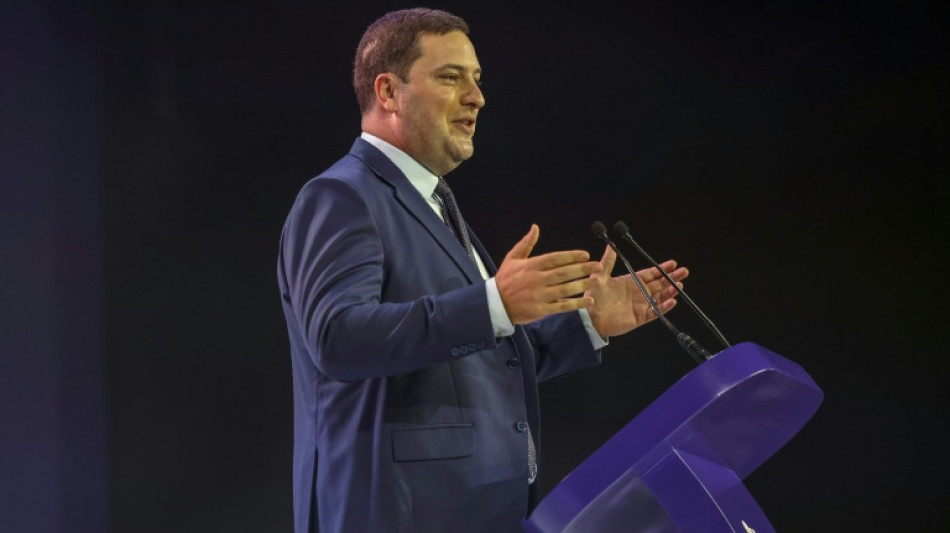
South Africa's new DA leader vows to shed party's white image / Photo: Ilaria Finizio - AFP
The new leader of South Africa's second-largest party, the Democratic Alliance, said Monday he would recast it beyond its white-voter base, betting that the country's once rigid racial divides are easing.
Geordin Hill-Lewis was elected head of the centre-right DA at the weekend ahead of local polls expected in less than a year.
He replaces John Steenhuisen, who announced in February that he would not run for a third term of the party's leadership.
The pro-business party will seek to tap mounting public frustration with political dysfunction and failing services, the Cape Town mayor told reporters.
"I really want to focus the party on communicating and most importantly demonstrating that we genuinely care about the advancement of every South African, regardless of the circumstances of their birth," he said.
"For a long time, the kind of racial silos in South Africa have been very firm and concrete but they are cracking and breaking down," he said, adding that voters are gravitating toward those who deliver results.
Winning broader support will be hard, Hill-Lewis warned.
"Its not about overnight success. It is about steady one foot in front of the other in the right direction," he said.
South Africa is currently led by a tense 10-party coalition, including the DA, after the largest party African National Congress (ANC) lost its 30-year majority in the 2024 national elections.
The DA holds six cabinet positions compared to 20 for the ANC which is accused of sweeping corruption, mismanagement and nepotism.
Formed in 2000 as a merger of three mostly white parties, the DA, which runs on a liberal, free-market agenda, has struggled to stave off its white, middle-class identity and win over black voters.
At the elections in 2019, when it was led by a black man, it won about 20 percent of the vote.
In the 2024 polls, it improved its showing to 22 percent and recent polling by the Ipsos market researcher showed a similar level of support ahead of local government polls due between November and January.
Hill-Lewis said the party would not abandon its opposition to contentious issues such as Black economic empowerment, national health insurance and social grants -- long-running flashpoints in South African politics.
With unemployment hovering around 31 percent, millions rely on welfare, while empowerment laws aim to redress deep inequalities inherited from apartheid.
"That is the first hurdle we have to overcome. We have to make it clear to black South Africans that we are genuinely invested in and care about their advancement, but we do not support the current model of elite enrichment," Hill-Lewis said.
White South Africans account for a little more than seven percent of the country's 63‑million people.
Hill-Lewis, 39, became mayor in 2021 of tourist-magnet Cape Town, seen as among the better-managed municipalities in the country.
F.Dubois--JdB