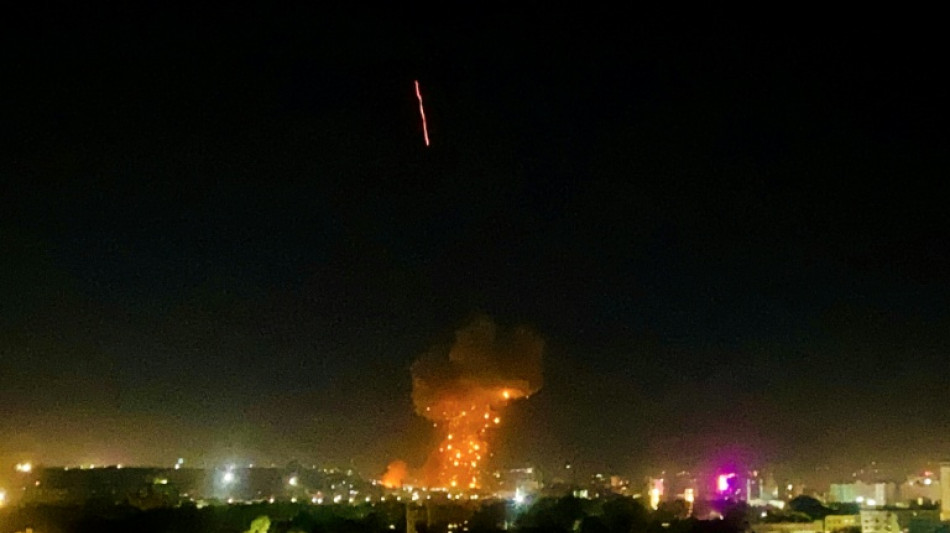
Afghanistan accuses Pakistan of deadly airstrike on drug rehab centre in Kabul / Photo: STRINGER - AFP
Heavy casualties were feared on Tuesday after Afghanistan accused Pakistan of hitting a treatment centre for drug addicts in the capital, Kabul, and killing civilians.
Pakistan denied deliberately targeting the facility, instead saying it had conducted precision strikes on "military installations and terrorist support infrastructure".
The Pakistani military has struck Kabul several times in recent weeks, as part of a conflict sparked by claims that the Taliban government has harboured extremists who have carried out attacks across the border.
Loud explosions rocked the city at 9:00 pm local time (1630 GMT) on Monday, prompting return anti-aircraft fire and forcing locals to run for cover in panic as they were out and about after breaking their daily Ramadan fast.
Taliban government spokesman Zabihullah Mujahid wrote on X that Pakistan had "once again violated Afghan territory", calling the strikes "a crime" and an "act of inhumanity".
Once anti-aircraft guns stopped at about 10:00 pm, an AFP team was able to reach the rehabilitation centre and saw fleets of ambulances and firefighters brought in to douse flames in burning and destroyed buildings.
AFP journalists counted at least 30 dead bodies as medical teams worked to help the wounded, who were taken to several hospitals for treatment, according to a source working with the rescue operation.
Dejan Panic, Afghan director of the Italian NGO Emergency, said it had received three bodies after the strike on Monday night and was treating 27 wounded.
But health ministry spokesman Sharafat Zaman told AFP: "The preliminary reports are that so far we have more than 200 martyrs and more than 200 injured."
Deputy government spokesman Hamdullah Fitrat, however, said the death toll was at least double that, with 250 wounded.
- 'No off-ramps' -
Long-running cross-border clashes between Afghanistan and Pakistan escalated in October last year, leaving dozens dead, but after subsiding they resumed last month, with Pakistan describing the conflict as "open war".
On Friday, the United Nations mission in Afghanistan confirmed the deaths of at least 75 civilians in the country since clashes with Pakistan intensified on February 26.
Pakistan said it also hit targets on Monday in the eastern border province of Nangarhar, which was also being used "against innocent Pakistani civilians".
"Pakistan's targeting is precise and carefully undertaken to ensure no collateral damage is inflicted," the information ministry said.
Omid Stanikzai, 31, a security guard at the drug treatment centre, told AFP: "I heard the sound of the jet patrolling.
"There were military units all around us. When these military units fired on the jet, the jet dropped bombs and a fire broke out."
All of the dead and injured were civilians, he added.
China said on Monday that its special envoy has spent a week mediating between the two sides and had urged an immediate ceasefire.
But South Asia expert Michael Kugelman, from the Atlantic Council international affairs think-tank, told AFP the fighting showed little sign of ending soon.
"The Arab Gulf nations that mediated previous rounds of Afghanistan-Pakistan talks are now bogged down by their own war. Other mediators, including China, have had limited success," he said.
"Pakistan appears intent to keep hitting targets in Afghanistan, and the Taliban determined to retaliate with operations on Pakistani border posts and potentially with asymmetric tactics -- from launching drones to sponsoring militant attacks in wider Pakistan.
"There are no off-ramps in sight."
The World Food Programme (WFP) said on Sunday that it has started delivering "life-saving food" to over 20,000 displaced Afghan families and warned that "further instability will push millions into hunger".
burs-iw/phz/ksb
R.Vandevelde--JdB