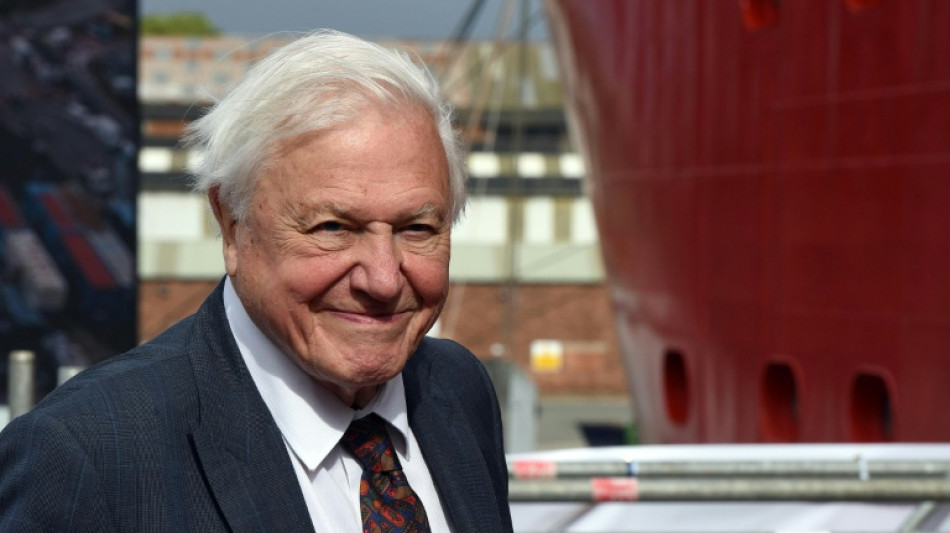
100 years on Earth: Iconic naturalist Attenborough marks century / Photo: Asadour Guzelian - POOL/AFP
David Attenborough, a leading voice on climate change and biodiversity loss whose landmark documentaries transformed popular understanding of the natural world for a global audience, marks his 100th birthday on Friday.
Attenborough's natural history series, such as "Life on Earth", in which he had a famous encounter with mountain gorillas in Rwanda, have brought the most remote corners of the planet into living rooms worldwide.
"He's taken us all to places that we would never otherwise go. That's a huge gift," botanist Sandra Knapp, director of research at London's Natural History Museum, told AFP.
The BBC is leading the celebration of the Briton's centenary with a full week of programming dedicated to his life.
Classic episodes of series including "Planet Earth II" and "Blue Planet II" are being reshown along with others such as "Life in the Freezer" and "Paradise Birds" available on the BBC's iPlayer service.
The centrepiece will be a 90-minute live show on his birthday from London's Royal Albert Hall.
Knapp said Attenborough's programmes had "expanded people's horizons" and been an inspiration to many.
Jean-Baptiste Gouyon, professor of science communication at University College London (UCL), said Attenborough had made natural history as popular as football.
Attenborough's programmes succeeded in instilling in the public an unparallelled passion and wonder for the natural world, said Gouyon.
Attenborough's lifelong passion for the natural world began as child, and he went on to study geology and zoology at university.
Prince William, heir to the UK throne, has described him as a "national treasure". Attenborough was also a firm favourite of the late Queen Elizabeth II, who knighted him in 1985.
Showing Attenborough's cross-generational appeal, US singer-songwriter Billie Eilish has praised his "deep love and knowledge of our planet", adding: "The animal kingdom brings out the childlike curiosity within us all."
- Mountain gorillas -
Attenborough has often reflected on his "luck" in being able to "find and film rare creatures that few outsiders have seen in the wild".
And he has said he has been able "to gaze on some of the most marvellous spectacles that the wild places of the world have to offer".
In 2006, he added his voice to those raising the alarm on climate change and biodiversity loss.
He declared himself "no longer sceptical" about the issue, having waited for conclusive proof that humanity was changing the climate.
Attenborough's broadcasting career spanning nearly eight decades has been closely associated with the BBC, which he joined in the early 1950s.
"Life on Earth", released in 1979, has alone been watched by 500 million people worldwide, while dozens of documentaries and associated books have made him a household name.
Recalling the series' highlight, when he unexpectedly found himself up close with a group of mountain gorillas, Attenborough described the experience as "bliss" and "extraordinary".
"I was simply transported," he said ahead of his centenary, reliving how the adult female twisted his head and looked straight into his eyes and her two youngsters sat on him as the cameras rolled.
- 'Modern colonialism' -
Still making documentaries well into his nineties, he used his 2025 film "Ocean" to condemn the industrial fishing methods of wealthy nations, which he called "modern colonialism at sea".
Despite his fame, the broadcaster -- whose brother was the late actor and film director Richard Attenborough -- has always refused to be seen as a celebrity.
Gouyon said Attenborough always made sure to direct the viewer's gaze back to the subject matter.
On the threat to the natural world, Attenborough has said he hopes humanity will be able to change course.
"Perhaps the fact that the people most affected by climate change are no longer some imagined future generation, but young people alive today... will give us the impetus we need to rewrite our story, to turn this tragedy into a triumph," he said at the UN Climate Summit in Glasgow in 2021.
"We are, after all, the greatest problem-solvers to have ever existed on Earth," he said.
At 100, Attenborough no longer wanders the world's jungles and deserts.
But he has continued to tell the story of the planet closer to home.
In "Wild London", broadcast in early 2026, he marvels at the wildlife of the British capital, his birthplace, from foxes and beavers to hedgehogs and harvest mice.
After all his travels, he has confided that his favourite place remains Richmond, an affluent and leafy suburb in southwest London.
He has lived in the riverside town for many years, and still resides in the family home he shared with his late wife Jane and their two children.
E.Carlier--JdB