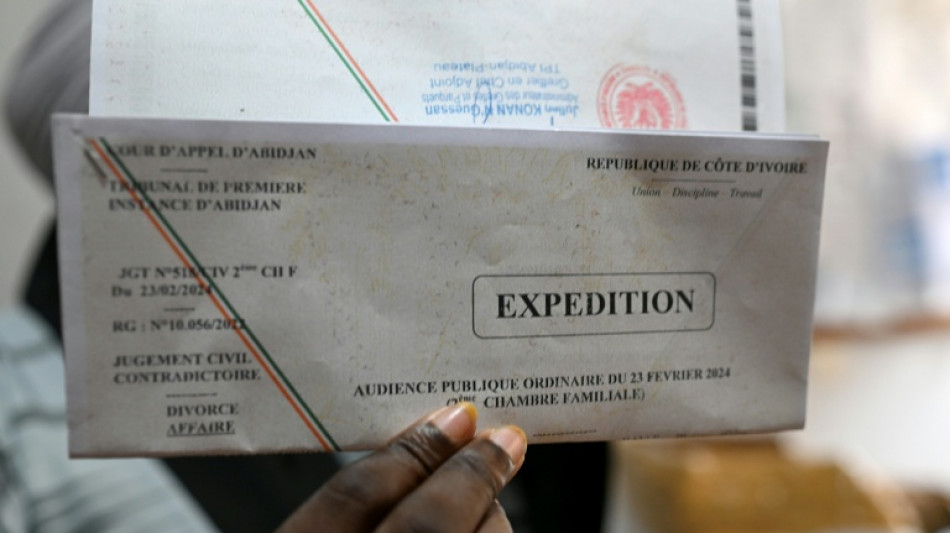
'Rein in your heart': I.Coast women trapped by divorce taboo / Photo: Issouf SANOGO - AFP
Josy's life was turned upside down three years ago when she discovered that her husband had racked up crippling debts and was cheating on her.
Yet she can't bring herself to divorce him for fear of social disapproval in Ivory Coast. Others in her situation also cite a plethora of reasons, ranging from an agonisingly slow judicial process to high costs and the traditional advice to "rein in your heart".
Like other countries in Africa, Ivory Coast has a low divorce rate, with only 1,835 divorce petitions for 30,912 marriages in 2024, according to official figures.
Josy, a healthcare professional who earns 500,000 CFA francs a month ($875), a decent salary in Ivory Coast, has been "sharing digs" with her husband despite "severe tensions at home".
"Honestly, I still don't have the courage to face society, family and the church," she said.
"In Africa, a divorced woman is singled out. African mothers always say 'there's nothing you can't put up with,' and 'for us Christians, divorce is forbidden'."
"Sometimes there are women who prefer to flee to other countries," -- an option she is considering, Josy said.
- 'Keep your mouth shut' -
Anne Bera-Dasse, a lawyer specialising in family law for over three decades, told AFP that women only resort to divorce "in fairly extreme situations".
For her, the cumbersome nature of the process -- especially when it is not by mutual consent -- which can take years, "discourages" women and also entails significant financial costs.
Another impediment is that women often quit working when they get married or aren't financially independent.
"I really want a divorce but I can't afford it," said Nina, 40, whose husband left five years ago with three of their four children.
"I'm struggling" to see the children, she said.
Corine Moussa Vanie, chair of the board of Akwaba Mousso, an association which supports women victims of violence, said "everything is set up to always try to reconcile couples".
She added that the "real challenge lies in the structure of Ivorian society.
"Even if you have degrees, for a woman the pinnacle of success is marriage," she said.
The definition of a "good husband" is a man "who has money", she added.
"Recently my husband bought me a car, so when my parents found out, they said that whatever happens in your home, you mustn't say anything, you have to keep your mouth shut," she said, noting that her parents are "intellectuals".
"In our culture, we're taught that a household automatically means 'hardship'," said the self-proclaimed feminist.
As long as a woman's "life is not in danger", women rarely divorce and "prefer to stay... just to keep up appearances", she said.
"Each living their own life. But the main thing: they're married."
– 'Live for myself' –
That was a situation Yacine, 42, refused to accept.
Divorced after a two-year legal process, she says she has recovered her "health, peace of mind" and is finally on "good terms" with her ex-husband.
"Today my children are happy... to see me happy," she said.
But when she launched the divorce proceedings, the cashier, who earns about 200,000 CFA francs a month, told no one but a lawyer, with whom she faced the trial alone.
She admitted that she knew nothing about how the legal system works.
"It was exhausting" to "keep going back to court", she recalled. "Everyone's there, they ask you embarrassing questions."
"In Africa, we live for other people. Women don't have confidence in themselves... it's this lack of confidence that makes people afraid of divorce," she said.
While Yacine now has a suitor, she is wary of putting on a ring again given her past experience.
"I want to live for myself," she said.
*All the first names of the women interviewed have been changed.
W.Lejeune--JdB