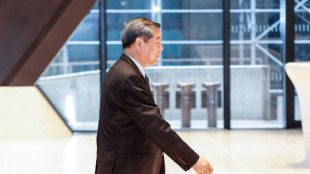
South Korean ex-PM Han gets 23 years jail for martial law role / Photo: Chung Sung-Jun - POOL/AFP
Former South Korean prime minister Han Duck‑soo was sentenced to 23 years in prison on Wednesday for aiding and abetting a declaration of martial law that briefly suspended civilian rule and plunged the country into chaos.
The defendant "disregarded his duty and responsibility as prime minister until the very end", said Judge Lee Jin-gwan, of the Seoul Central District Court.
"We sentence the defendant to 23 years in prison."
The sentence is eight years longer than prosecutors demanded.
The 76-year-old career technocrat was ordered to report to prison immediately after the ruling.
Judge Lee said the martial law decree by Han's boss Yoon Suk Yeol in December 2024 was intended with the "aim of subverting the constitutional order" and amounted to insurrection.
Yoon's stunning imposition of martial law saw armed troops deployed to the National Assembly and the National Election Commission before it was vetoed by the opposition‑led parliament.
In the aftermath, Yoon was impeached and removed by the Constitutional Court in April, triggering an election two months later.
Han is one of many former officials -- including Yoon -- who have stood trial over their roles in the martial law attempt.
"The defendant is deemed to have played a significant role in the insurrectionary acts of Yoon and others by ensuring, at least formally, compliance with the procedural requirement," Judge Lee said in a televised sentencing.
Lee pointed out that while Han "voiced concerns to Yoon" over the move, he failed to "explicitly oppose it" or urge other cabinet members to dissuade Yoon from it.
During the course of the trial, Han denied wrongdoing, insisting he had never supported or helped the martial law declaration.
– 'Palace coup' –
After Yoon was removed from office in April, Han assumed his post as acting president and was at one point seen as a strong conservative contender in the snap election.
He resigned from the role in May to pursue a presidential bid, which soon collapsed when Yoon's party refused to nominate him as its standard‑bearer.
The court said Yoon's martial law had been carried out as a "top-down insurrection" and could be understood as a "palace coup".
Despite the unconstitutional elements of the move, not only did Han choose not to oppose it but decided to partake in it, the judge said.
"The defendant... bore a duty as prime minister to comply with the Constitution and laws and to make every effort to uphold and realise the Constitution," he said.
"Nevertheless, believing that the Dec. 3 insurrection might succeed, he ultimately turned his back on these duties and responsibilities and chose to take part in it."
Han was also convicted of perjury.
The Wednesday verdict comes after former president Yoon was sentenced to five years in prison for obstructing justice and other crimes linked to his martial law move.
He is also facing a verdict over his central role as the ringleader of the insurrection in the decree for which prosecutors are calling for the death penalty.
The Seoul Central District Court -- presided over by a different judge from Han's trial -- will deliver its ruling on February 19.
T.Peeters--JdB