What to know about China's drills around Taiwan / Photo: ADEK BERRY - AFP
China's military drills around Taiwan entered their second day on Tuesday, the sixth major manoeuvres Beijing has held near the self-ruled island in recent years.
AFP breaks down what we know about the drills:
- What are the drills about? -
The ultimate cause is China's claim that Taiwan is part of its territory, an assertion Taipei rejects.
The two have been governed separately since the end of a civil war in 1949 saw Communist fighters take over most of China and their Nationalist enemies flee to Taiwan.
Beijing has refused to rule out using force to achieve its goal of "reunification" with the island of 23 million people.
It opposes countries having official ties with Taiwan and denounces any calls for independence.
China vowed "forceful measures" after Taipei said this month that its main security backer, the United States, had approved an $11 billion arms sale to the island.
After the drills began on Monday, Beijing warned "external forces" against arming the island, but did not name Washington.
China also recently rebuked Japanese Prime Minister Sanae Takaichi after she said the use of force against Taiwan could warrant a military response from Tokyo.
- What do the drills look like? -
Chinese authorities have published a map showing several large zones encircling Taiwan where the operations are taking place.
Code-named "Justice Mission 2025", they use live ammunition and involve army, navy, air and rocket forces.
They simulate a blockade of key Taiwanese ports including Keelung in the north and Kaohsiung in the south, according to a Chinese military spokesperson and state media.
They also focus on combat readiness patrols on sea and in the air, seizing "comprehensive" control over adversaries, and deterring aggression beyond the Taiwanese island chain.
China says it has deployed destroyers, frigates, fighters and bombers to simulate strikes and assaults on maritime targets.
Taipei detected 130 Chinese military aircraft near the island in the 24 hours to 6:00 am on Tuesday (2200 GMT on Monday), close to the record 153 it logged in October 2024.
It also detected 14 Chinese navy ships and eight unspecified government vessels over the same period.
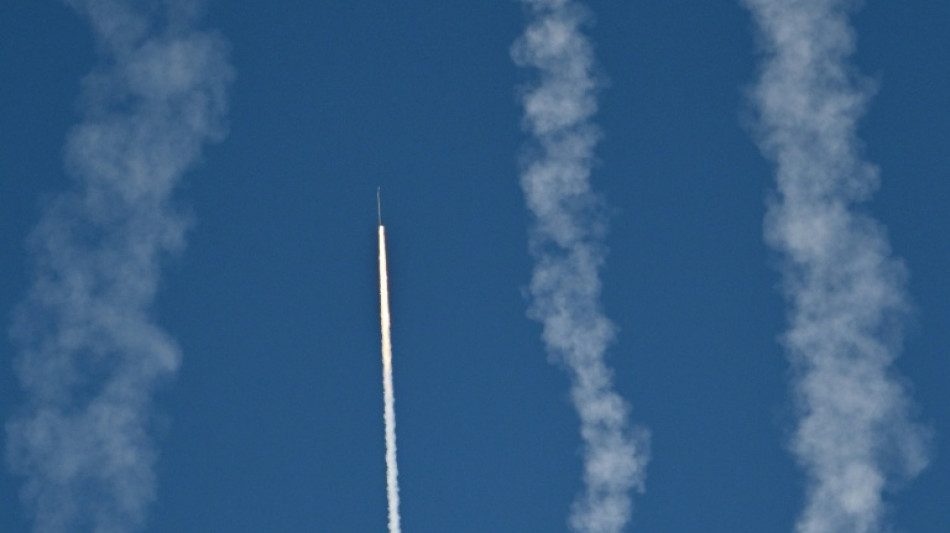
AFP journalists stationed at China's closest point to Taiwan saw at least 10 rockets blast into the air on Tuesday morning.
- How has Taiwan responded? -
Taipei has condemned China's "disregard for international norms and the use of military intimidation".
Its military said it has deployed "appropriate forces" and "carried out a rapid response exercise".
President Lai Ching-te said China's drills were "absolutely not the actions a responsible major power should take".
But he said Taipei would "act responsibly, without escalating the conflict or provoking disputes".
US President Donald Trump has said he is not concerned about the drills.
- How common are the drills? -
This is China's sixth major round of manoeuvres since 2022 when a visit to Taiwan by then-US House Speaker Nancy Pelosi enraged Beijing.
Such activities were rare before that but China and Taiwan have come close to war over the years, notably in 1958.
China last held large-scale live-fire drills in April, surprise manoeuvres that Taipei condemned.
This time, Beijing is emphasising "keeping foreign forces that might intervene at a distance from Taiwan", said Chieh Chung, a military expert at the island's Tamkang University.
- What are analysts saying? -
"China's main message is a warning to the United States and Japan not to attempt to intervene if the CCP (Chinese Communist Party) uses force against Taiwan," Chieh told AFP.
But the time frame signalled by Beijing "suggests a limited range of activities", said Ja Ian Chong, an associate professor at the National University of Singapore.
Falling support for China-friendly parties in Taiwan and Beijing's own army purges and slowing economy may also have motivated the drills, he said.
But the goal was still "to cow Taiwan and any others who might support them by demonstrating that Beijing's efforts to control Taiwan are unstoppable".
T.Peeters--JdB