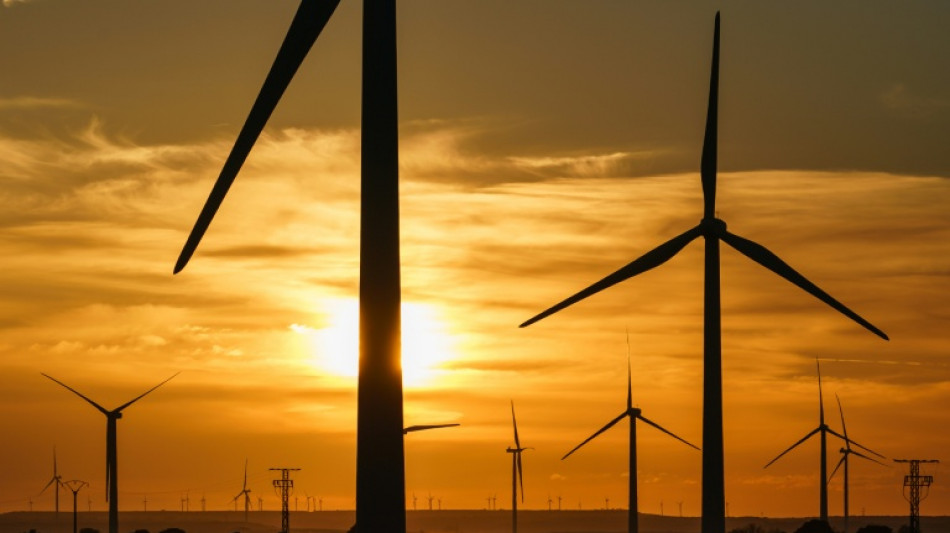
EU will struggle to secure key raw materials supply, warns report / Photo: CESAR MANSO - AFP/File
The European Union must step up its efforts to secure supplies of critical raw materials by 2030 if it wants to break its dependence on foreign countries and meet its climate goals, a watchdog warned on Monday.
Raw materials such as lithium, nickel and cobalt are essential for electronic goods such as batteries and wind turbines and needed for the EU's green transition.
Brussels wants more European production to avoid a repeat of the supply shocks seen during the Covid pandemic or after Russia's 2022 invasion of Ukraine. It also seeks to challenge Beijing's stranglehold on critical materials which threatens key EU industries.
But the 27-country bloc is struggling to diversify its imports of the key materials, ramp up domestic production, and recycling is "still in its infancy", according to a report by the European Court of Auditors (ECA).
The EU needs to secure the supply of such minerals to meet its energy and climate goals -- with a target of climate neutrality by 2050.
The study analysed the EU's efforts after the adoption of the Critical Raw Materials Act in 2024, aimed at ensuring the long-term secure supply of 26 minerals necessary for Europe's energy transition.
The law set several non-binding targets:
-- the EU must meet 10 percent of its extraction needs, 40 percent of its processing and 25 percent of its recycling needs for each strategic material
-- the bloc must not rely on any one non-EU country for more than 65 percent of its strategic raw material needs.
The auditors said "there is still a long way to go to meet the targets".
When the law was adopted, domestic mining capacity for the strategic raw materials accounted for around eight percent of the 27-country EU's annual consumption.
Meanwhile EU processing accounted for 24 percent of its needs and 12 percent of its recycling capacity, the ECA said.
For example, China supplies 97 percent of the EU's magnesium, used in hydrogen-generating electrolysers while Turkey provides 99 percent of the bloc's boron, used in solar panels.
Meanwhile, Chile supplies 79 percent of the EU's lithium, used in batteries for electric cars.
"We are now dangerously dependent on a handful of countries outside the EU for the supply of these materials," said the ECA's Keit Pentus-Rosimannus.
"It is therefore vital for the EU to up its game and reduce its vulnerability in this area," Pentus-Rosimannus said.
Brussels has focused on diversifying imports through strategic partnerships on raw materials. But despite signing 14 of them, the ECA found imports fell between 2020 and 2024 for around half of the raw materials examined.
G.Lenaerts --JdB