Mumbai Green Building Congress Unveils New Rating Systems and Global Partnerships
The Green Building Congress 2026 opened in Mumbai on Thursday, marking a shift from policy promises to practical implementation in India’s sustainable construction sector. The event featured the launch of five new rating systems and strategic partnerships aimed at expanding green infrastructure beyond residential and office spaces.
India’s green building sector advanced from policy commitments to practical implementation in Mumbai on Thursday, with the launch of five new rating systems and two major strategic partnerships. The developments were unveiled during Day One of the Green Building Congress 2026, the 24th edition of the Confederation of Indian Industry-Indian Green Building Council’s (CII-IGBC) flagship event, held at the Jio World Centre in Bandra Kurla Complex.
The three-day congress, running from November 26 to 28, is themed "Forging a Sustainable Future – Do Good, Feel Good. Building Greener Worlds Together." The event underscores a growing emphasis on making net-zero construction the industry standard rather than an exception.
Maharashtra continues to lead the national green building movement. According to data presented at the congress, India’s total green building footprint has exceeded 16.55 billion square feet across more than 20,620 registered projects. Maharashtra alone accounts for approximately 5.01 billion square feet, comprising over 4,754 IGBC-certified projects. Speakers at the event noted that this concentration of green infrastructure places a specific responsibility on Mumbai to demonstrate how sustainable construction translates into healthier homes, cleaner air, lower utility bills, and more resilient neighborhoods.
The congress opened with HRH Princess Ashi Sonam Dechan Wangchuk of Bhutan calling for cities to be developed in harmony with nature. She emphasized that buildings play a central role in tackling climate change, protecting communities, and building resilience, noting that the response must be collective, collaborative, and inter-generational.
She was joined on stage by Vir S. Advani, Chairman of the CII Western Region Council and CMD of Blue Star Limited; Cristina Gamboa, CEO of the World Green Building Council; Jeff Oatman, Chair of the Asia Pacific Regional Network of the World Green Building Council; B. Thiagarajan, Immediate Past National Chairman of CII-IGBC and MD of Blue Star Limited; and C Shekar Reddy, National Chairman of CII-IGBC.
During his address, Oatman highlighted the necessity of global partnerships to achieve low-carbon, inclusive, and resource-efficient development. Thiagarajan outlined three key milestones for the industry: mainstreaming green buildings by 2030, scaling net-zero buildings and communities by 2035, and contributing to India’s broader net-zero commitment by 2070. Shekar Reddy traced IGBC’s 25-year journey, stressing the need to accelerate decarbonization and ensure inclusive growth.
The most significant announcement of the day was the introduction of five pilot rating systems designed to extend green building standards beyond traditional office and residential sectors. The new systems include Green Retail, DigiBuild, Health and Well-being, Green Healthcare Facilities, and Green Service Building. These frameworks will cover shops, digital infrastructure, workplaces, hospitals, and service buildings—spaces where residents spend a significant portion of their daily lives.
To support international expansion, IGBC signed a Memorandum of Understanding (MoU) with Bhutan’s National Housing Development Corporation Limited (NHDCL). The agreement aims to promote green buildings in Bhutan through technical guidance, capacity building, training, support for standards and policies, knowledge exchange, and visits to IGBC-certified projects.
Maharashtra Governor Jishnu Dev Varma addressed the special plenary session, stating that sustainable development must directly improve the quality of life by providing healthier homes, clean air and water, lower energy consumption, and resilient communities. He commended CII-IGBC for its significant contribution to India’s green and net-zero building movement over the past 25 years.
Varma cited several state initiatives, including the State Action Plan on Climate Change, the Majhi Vasundhara Abhiyan, the Mumbai Climate Action Plan, water conservation efforts, and renewable energy promotion. He highlighted the state’s target of achieving 50% renewable energy by 2030.
Dr. Niranjan Hiranandani, Chairman of NAREDCO and Founder & Chairman of the Hiranandani Group, emphasized that the real estate and construction sectors must embed sustainability through innovation, technology, and responsible practices. During the event, IGBC’s Coffee Table Book, featuring over 100 exemplary green and net-zero projects from across India, was unveiled in the Governor’s presence.
A R Unnikrishnan, National Vice Chairman of CII-IGBC, called for turning commitments into measurable action. The congress also recognized winners of the Green Your School Programme, IGBC Green Design Competition, and IGL Awards.
In a move to address healthcare infrastructure, IGBC signed another MoU with the Consortium of Accredited Healthcare Organisations (CAHO). Signed by Dr. Lallu Joseph, President of CAHO, and S. Karthikeyan, Executive Director of IGBC GreenPro and CIES at the CII Green Business Centre, the pact aims to promote sustainable, resource-efficient, and climate-resilient healthcare infrastructure.
The agreement will push the adoption of the Green Healthcare Facilities Rating System through joint research, knowledge sharing, capacity building, and policy advocacy. Focus areas include energy and water efficiency, resource optimization, reducing healthcare-associated infections, and enhancing climate resilience. Karthikeyan stated that the tie-up would help hospitals and medical colleges integrate sustainability into design, construction, and operations, while Dr. Joseph noted that healthcare must remain environmentally responsible without compromising patient safety.
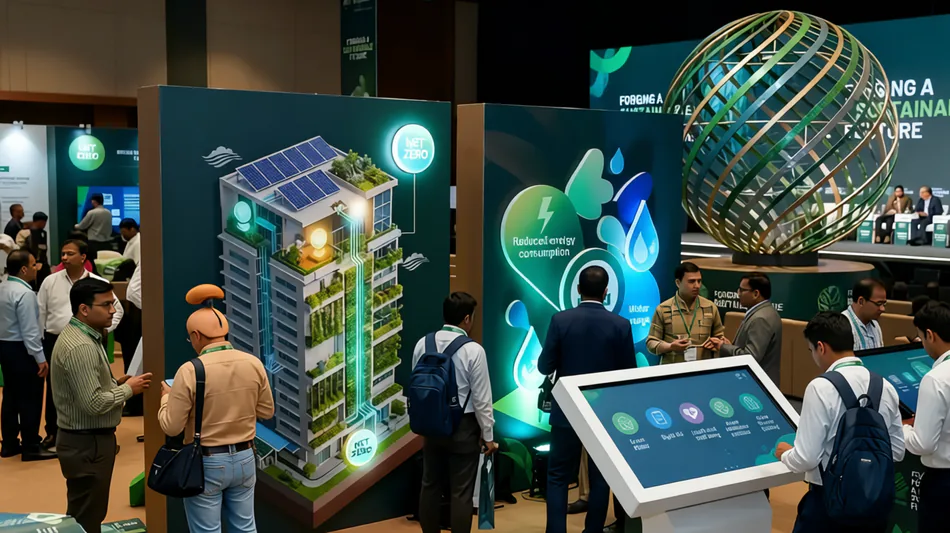
The event also featured a Green Building Congress Expo with nearly 200 stalls showcasing green products, technologies, and services. The proceedings in Mumbai signaled a shift in the industry, positioning green building not as a niche interest but as the emerging standard for construction in India, with Maharashtra leading the charge.
Y.Simon--JdB