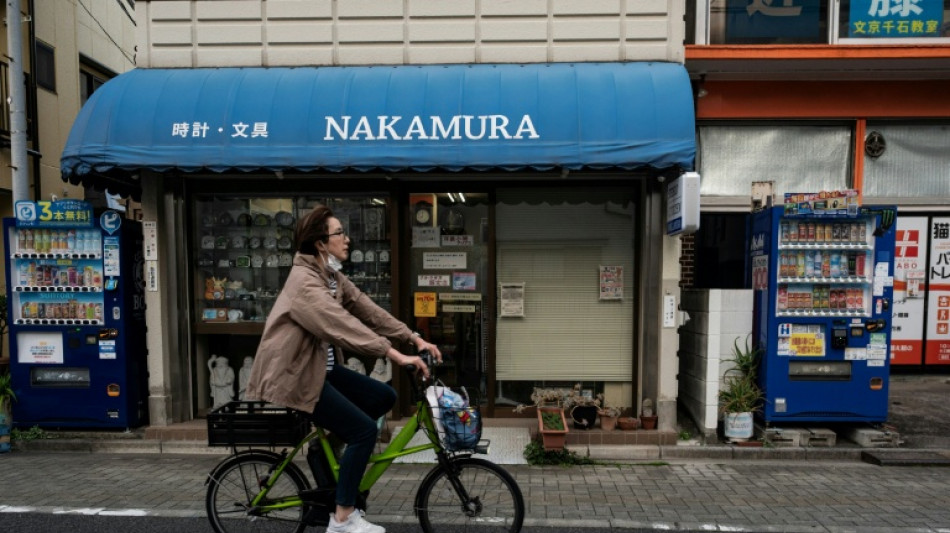
Japan inflation cools demand for vending machine drinks / Photo: Andrew CABALLERO-REYNOLDS - AFP
From post offices and parks to stations and even the summit of Mount Fuji, Japan's vending machines are ubiquitous. But with the rapid pace of inflation cooling demand for their drinks, operators are being forced to rethink the business.
Last month beverage giant DyDo Group Holdings announced it would remove about 20,000 vending machines -- around seven percent of their stock nationwide -- by January 2027, in order to "reconstruct a profitable network".
Pokka Sapporo Food & Beverage, based in Nagoya, also said in March it would sell its 40,000-machine operation to Osaka-based Lifedrink Co.
"The strength of the vending machine business has been to sell at list prices," a spokeswoman for Pokka Sapporo told AFP.
But "a rise in list prices is pushing more people to look to shops that sell drinks at a discount", she said.
Tetsuharu Kawaguchi, 31, who works for a food delivery company, said cost was the leading factor in his decision to ditch vending machines -- which stock a host of Japan's favourite thirst-quenchers from iced tea to canned coffee.
From a machine, even "water... ends up being around 130 yen (80 cents). If you go to a convenience store, you can sometimes get it a bit cheaper, and places like drugstores often sell it for quite a low price", he explained.
While Japan was long haunted by deflation, it has more recently faced a surge in living costs.
Kazuhiro Miyashita of Inryo Soken, a research institute focused on the beverage industry, told AFP that increased costs for fuel and staff to keep machines stocked were eating into profits.
"If they can curb prices through cost-cutting, they may be able to hold their own against convenience stores."
Takayuki Ishizaki of Nomura Research Institute said that growing environmental awareness was also playing a part in the troubling situation for operators.
It "has led some people to stop buying drinks outside and instead bring their own bottles (to refill)", he said.
Despite the decline, vending machines -- where ramen noodles, cut fruit, kimchi and crepes are also on offer -- are unlikely to disappear anytime soon.
"Ultimately the overwhelming convenience of being able to find one just by walking a short distance practically anywhere (in Japan) is something that can't really be replaced," Ishizaki said.
"The move now is toward being more strategic and selective in terms of placement."
Taisuke Oguro, 27, a hairdresser in Tokyo, is holding out for their survival.
"In places where there aren't any convenience stores, I do think it's actually pretty handy to have one," he said.
Y.Simon--JdB