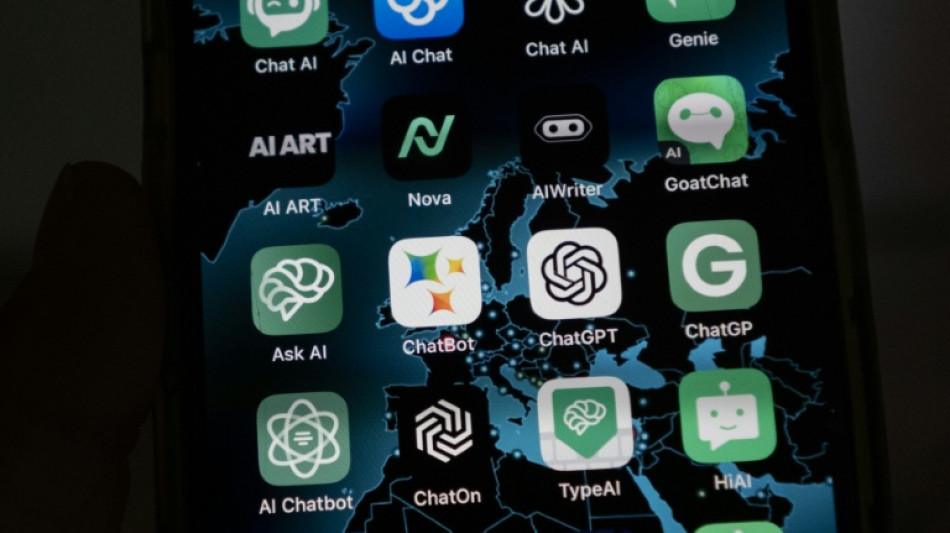
'Stop hiring humans'? Silicon Valley confronts AI job panic / Photo: OLIVIER MORIN - AFP/File
AI industry insiders want workers to code smarter, think harder and lean into their humanity -- but still dodge the question of how many jobs artificial intelligence will destroy.
The reassurance rang out across HumanX, a four-day conference drawing some 6,500 investors, entrepreneurs and tech executives, even as a blunt advertisement at the entrance set the tone: "Stop hiring humans."
On the main stage, May Habib, chief executive of an AI platform called Writer, told the audience that Fortune 500 bosses are having a "collective panic attack" on the subject.
The anxiety is well-founded. More and more companies are directly citing AI in announcing job cuts.
High-profile examples are on the rise: Salesforce laid off 4,000 customer support workers, saying AI now handles 50 percent of its work.
Block chief Jack Dorsey announced plans to cut the company's headcount nearly in half, citing "intelligence tools" that have fundamentally changed how companies operate.
Not all claims have gone uncontested -- some economists say firms are pointing to AI to rationalize layoffs that are really about past overhiring or cost-cutting ahead of massive infrastructure investments.
OpenAI's Sam Altman has spoken of "AI-washing," and most speakers at the San Francisco event similarly dismissed the invocation of AI as a false pretext for job cuts -- even as they freely predicted disruption was just around the corner.
AI is going to "transform every single company, every single job, every single way that we do work," said Matt Garman, chief executive of cloud computing giant Amazon Web Services.
- 'Pretty unsettling' -
The debate remains heated. Two years ago, Nvidia chief Jensen Huang declared that the ultimate goal was to make it so "nobody has to program" or code.
"We will look back on that as some of the worst career advice ever given," Andrew Ng, founder of training platform DeepLearning.AI, shot back on Tuesday.
In his view, coding is not an obsolete skill -- AI has simply made it available to more people.
Another argument has taken hold in Silicon Valley: interpersonal skills will become more valuable than ever, with some voices going so far as to tout a humanities education as sound tech career preparation.
"As AI can do more of a job, the things that will distinguish and differentiate a given employee are going to be the human skills -- critical thinking, communication, teamwork," said Greg Hart, chief executive of training platform Coursera, which has seen enrollment in its critical thinking courses triple over the past year.
Florian Douetteau, chief executive of Dataiku, a French company specializing in enterprise AI, agreed.
The real human added value, he told AFP, is the "capacity for judgment."
He described a world in which an AI agent works through the night, its human counterpart reviews the results in the morning, and then the agent resumes working autonomously during the lunch break.
But the entrepreneur nevertheless expressed unease.
"We are going to have a generation of people who will never have written anything from start to finish in their entire lives," he said. "That's pretty unsettling."
- 'Mistake was not preparing' -
All of this advice risks ringing hollow for a generation already struggling to land a first job.
AI has automated entry-level tasks that once served as on-the-job training. Hiring of candidates with less than one year of experience fell 50 percent between 2019 and 2024 among America's major tech companies, according to a study by investment fund SignalFire.
"We should be preparing for the loss of knowledge work jobs in a number of categories," warned former US vice president Al Gore.
As the week's lone genuinely dissenting voice, Gore called for a real action plan to map threatened jobs and prepare workers for career transitions, so as not to repeat the mistakes of the globalization era.
"The mistake was not globalization. The mistake was in not preparing for the consequences of globalization," he said, drawing a parallel with the deindustrialization that followed the offshoring wave of the 2000s.
"Maybe we don't want to talk about it," he added, "because it may slow down the enthusiasm for the technology."
J.F.Rauw--JdB