China's overstretched healthcare looks to AI boom / Photo: Jade GAO - AFP
Throughout her first pregnancy, Wang Yifan had lots of questions, which she usually put to renowned obstetrician Duan Tao -- or rather, an AI clone of the top Shanghai-based doctor.
Duan has created a digital double for healthcare app AQ, which now boasts more than 100 million users in a display of how high-tech parts of China's medical sector have become.
A state-driven digitisation, aiming to inject efficiency into the overstretched healthcare system, has been underway for over a decade.
But with rapid developments in AI and robotics, the government, companies and practitioners see an opportunity to turbocharge that transition.
"Three to five years at most, and our entire medical model will be radically transformed," the soft-spoken Duan told AFP.
To train his avatar, Duan selectedmaterial, including textbooks, clinical case studies and content from his social platforms -- followed by more than 10 million -- to capture his tone.
The chatbot cannot prescribe medication, and AQ's maker, tech giant Ant Group, says it is not a substitute for treatment.
"At the beginning, I did have concerns," Duan said. "I value my personal reputation."
But he believes in "actively embracing" technology to help improve it.
- 'Democratising access' -
Beijing is soon expected to release its 15th Five-Year Plan, a blueprint for the world's second-largest economy until 2030 with technological transformation at its heart.
An October framework called for scientific breakthroughs to "enter practical application quickly", and referenced intelligent healthcare solutions.
AQ, or Afu in Chinese, now has more than 1,000 expert digital doubles.
The app "gives any ordinary user -- no matter where they are -- the opportunity to get good answers to their questions," Duan said.
"What we're doing is democratising access to medical knowledge."
That's especially appealing in China, where "waiting all morning for a three-minute appointment" is common, he said.
Within half a year, Duan's AI bot had 160,000 patients.
During Wang's pregnancy, digital Duan was a trusted mediator when she and her husband disagreed, for example on using cooking wine in food.
Since giving birth, she has used AQ even more, asking paediatrician avatars about rashes or for general care advice.
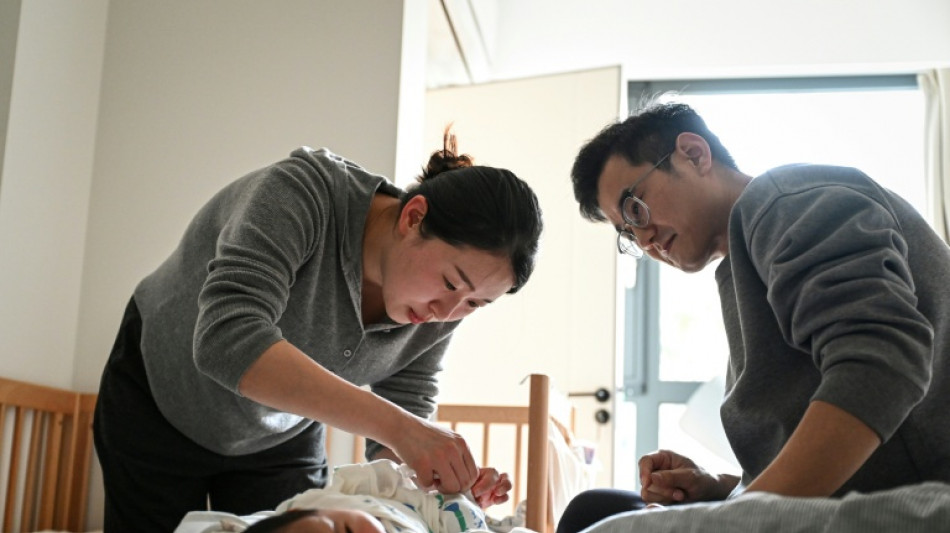
While the app can't replace doctors, "it can reduce the number of questions we need to ask doctors directly", Wang told AFP as her baby dozed in her Shanghai apartment.
"If I take my baby to hospital, I worry about cross-infection."
- 'Urgency drives change' -
China's vast population and territory have always posed challenges to consistent, evenly distributed healthcare –- and as its citizens age, stress on the system is increasing.
The challenges are similar to other countries', but are happening "at a greater scale and a greater pace", said Ruby Wang, a writer and director of LINTRIS Health consultancy.
"China's health technology landscape is maturing so quickly, partly because... urgency drives change," she said.
And "state-industry alignment allows many pilots to occur quickly", Wang added.
Chatbot DeepSeek is already used in hundreds of Chinese hospitals, according to one study, and Beijing's prestigious Tsinghua University runs a hospital it says is designed to use AI in almost all its processes.
Nationwide, there are more than 100 AI medical projects, an official said recently.
In a top Shanghai hospital, a specialised AI model called CardioMind supports cardiology diagnoses, while a tool called PANDA is being deployed, including in remote towns, to flag early stage pancreatic cancer.
Robotics companies tout their healthcare potential, with firms like Fourier already supplying rural rehab centres with devices like mechanical arms for physiotherapy.
Enthusiasm for AI in healthcare is signalled culturally too.
This year's televised Spring Festival Gala, a state broadcaster-run New Year ritual, featured a sketch that referenced AQ, and one starring humanoid robots caring for a neglected grandmother.
- Human decisions -
At a busy health centre in Shanghai, Yan Sulian, an energetic 65-year-old volunteer, helped older patients with electronic registration.
"Many elderly people just can't keep up with the smartphone era, so we volunteer to teach them how to adapt," she told AFP.
Yan said she and her friends all used AQ, after initially crosschecking its answers with doctors.
Life is already highly digitised in China, which explains the broad uptake of high-tech healthcare, said LINTRIS' Wang, with data and privacy not often cited as a concern.
Globally, its accuracy has come under scrutiny though.
Studies suggest while AI chatbots can match human doctors in exam conditions, they are less effective in messier, real-life conversations.
"We must always remember (AI) can hallucinate," obstetrician Duan said.
"Humans must retain the ultimate decision-making and choice."
But infectious disease expert Zhang Wenhong, a top doctor in China's Covid-19 fight, has voiced concerns that if AI becomes default, "without systematic training, doctors will lose the ability to judge whether AI's conclusions are correct".
Others emphasised that the adoption of AI in healthcare will be cautious.
"Doctors as a group are very conservative," Duan said.
"We insist on safety... because the nature of the profession puts us in that mindset."
R.Vercruysse--JdB