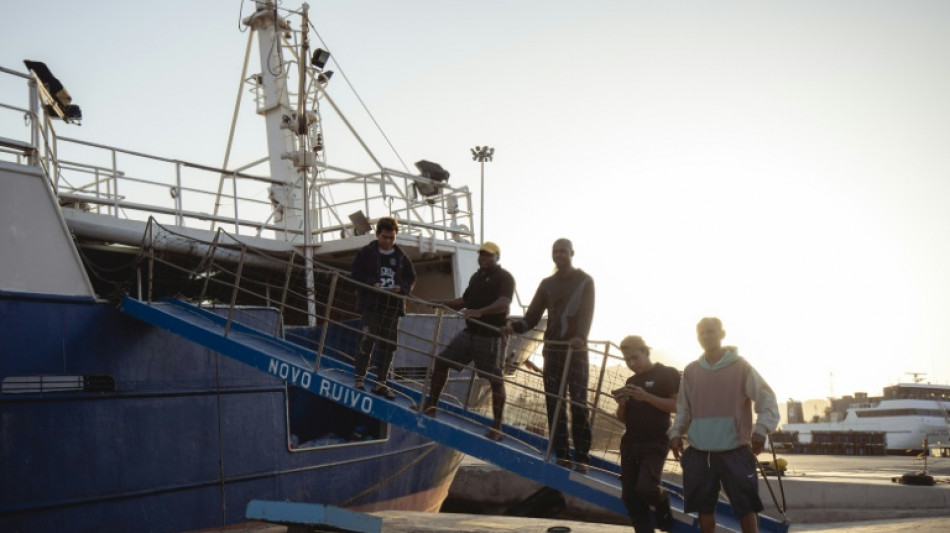
'Want to go home': Indonesian crew abandoned off Africa demand wages / Photo: Queila Fernandes - AFP
Abandoned for months on their fishing boat off West Africa, Indonesian sailor Surono and his shipmates face a dilemma: return home without almost a year's wages or stay on the docked vessel.
He is among a growing number of migrant workers abandoned by shipowners, who flout their obligations and desert crews without paying the salaries owed.
"My family cries because I can't get any money. My children and wife need money to eat," Surono, 47, who like many Indonesians goes by one name, told AFP from the abandoned ship in Cape Verde.
"We want to go home, but if we go home without money, then what? We've been working ourselves to the bone out at sea. How can we just be abandoned like that?"
The engine technician flew from Indonesia to Namibia in March 2025 to work onboard the Portuguese-flagged Novo Ruivo, a tuna longliner fishing boat.
But when they docked at Mindelo in Cape Verde in September to offload their catch, the owner left with the crew's passports and without paying their wages.
Surono said his salary was $1,200 a month and that with the five months stranded in Mindelo's Porto Grande, he is now owed $13,200.
The father-of-three admitted that his family in Tegal, Central Java, has struggled without this income, more than eight times the minimum wage there.
"This is really hard. To survive, I have to go into debt," his wife, Kiki Andriani, 38, told AFP through tears.
"I want my husband to come home, but if he does without his salary, then a whole year's work would be for nothing."
- Thousands stranded -
A ship is deemed abandoned by the International Labour Organization (ILO) under certain criteria, including when a shipowner does not cover the crew's repatriation costs or cuts ties with them and fails to pay wages for at least two months.
While fishing boats make up only a fraction of abandonment cases, overall figures for the shipping industry paint a worrying picture.
Reported cases reached record levels in 2025, with around 6,200 seafarers left stranded across 410 ships, according to figures released by the International Transport Workers' Federation (ITF) last month.
Surono contacted the ITF, who reported the Novo Ruivo abandoned to authorities and helped contact the Indonesian embassy in Dakar, Senegal.
"We offered them repatriation from day one, but they refused because they are afraid of not getting the money," said Gonzalo Galan, the ITF inspector handling the case.
The crew's last resort is getting a court order to seize and sell the boat to pay off the owner's debts, an option ITF is exploring with its legal team.
- 'Plenty of fish' -
The designated shipowner, Spaniard Javier Martinez of the Somar Produtos do Mar company, told AFP he does not have the money but is trying to solve the problem.
"They have not been abandoned. They have everything on the boat -- electricity, fresh water and food," he said.
"You think I'm not in more of a hurry than them to solve this? Having the boat parked there is costing me a lot of money."
Martinez said he sends each of the crew a stipend of around 50 euros ($60) every few weeks, which Surono said pays for phone credit, some snacks and drinks.
Workers in the fishing industry are covered by the ILO's work in fishing convention 188.
But the treaty, which aims to ensure a minimum standard is applied across the sector, is very weak and poorly implemented, Galan said.
"It basically just says that a fisher must have an employment contract in writing and that salaries should be paid in intervals, but does not specify the time frame," he said.
The crew of six Indonesians and six Angolans have mainly been living off old supplies of rice and frozen food, according to Surono, who said he spends "almost all day, every day on the boat".
"I have a fiancee waiting for me at home in Cirebon (West Java). We planned to get married soon," said crewmate Wahyudin, 36, who has also not been paid.
"If we didn't get any fish, I would've understood, but we got plenty of fish."
The recruitment agency in Indonesia that hired Surono agreed last week to front half his salary, but he is unlikely to see another penny should he leave, Galan said.
"The kids don't want to go to school because they're embarrassed about being behind on tuition. Even the neighbourhood shop won't trust us anymore," said Surono.
"I want my rights. We've worked, and we're asking for our wages because we have families."
S.Vandenberghe--JdB