Faberge's rare Winter Egg fetches record £22.9 mn at auction / Photo: HENRY NICHOLLS - AFP
Faberge's The Winter Egg, considered one of his most beautiful creations, sold for nearly £23 million ($30 million) at auction Tuesday in London, smashing the sales record for the legendary jeweller of Imperial Russia.
It is the third time the delicate bejewelled egg, which went under the hammer at Christie's auction house, has set an auction record for a work by Carl Faberge.
An as-yet unnamed buyer stumped up £22.9 million for the dazzling piece created more than a century ago, amid strong interest among international collectors, according to the London auctioneers.
It had put a pre-sale estimate price of more than £20 million on "the exquisite" crystal egg, commissioned by Russia's Tsar Nicholas II for his mother in 1913.
"Today's result sets a new world auction record for a work by Faberge, reaffirming the enduring significance of this masterpiece," Christie's Margo Oganesian said in a statement minutes after the hammer came down.
She added the sale celebrated "the rarity and brilliance of what is widely regarded as one of Faberge's finest creations, both technically and artistically".
The previous sales record for a Faberge egg -- the Rothschild Egg, which was not made for the imperial family -- had stood at nearly £9 million since it was sold in 2007 to a Russian collector.
Faberge, the master jeweller whose creations bedazzled Russia, created 50 Imperial Easter Eggs for the then-ruling Romanov family over a 31-year period, making them incredibly rare and valuable, Oganesian told AFP ahead of the auction.
They were commissioned as Easter gifts in a tradition started by Tsar Alexander III in the 1880s.
His heir Nicholas II had an annual standing order for two Easter Eggs to be made for his mother and his wife, until the fall of the Romanovs in the 1917 Russian Revolution.
Today, only 43 of the Imperial Easter Eggs remain, with seven missing.
The imperial eggs have enjoyed renewed interest on the art market in recent decades, mainly among wealthy Russians keen to acquire a piece of their country's history.
- 'One of the rarest' -
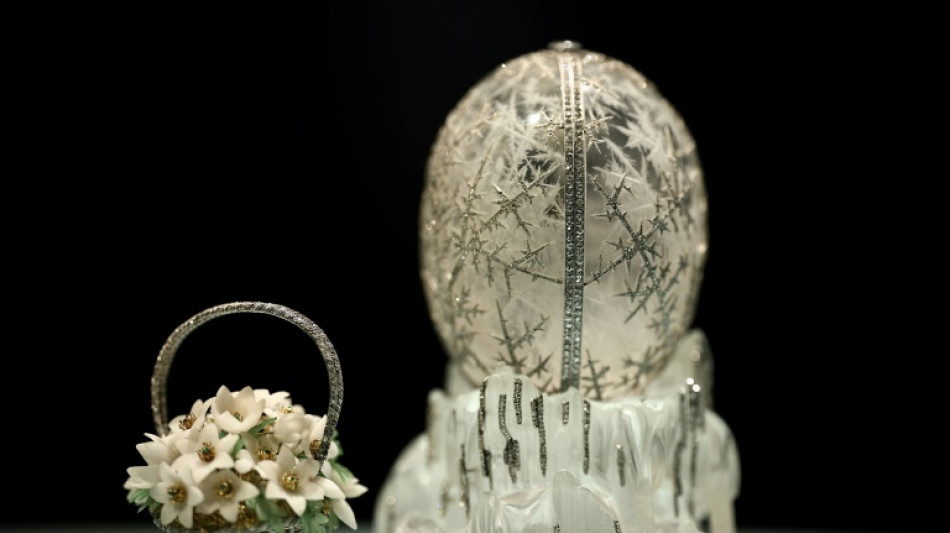
Carved from delicate rock crystal, the Winter Egg is an icy-looking orb studded with around 4,500 rose-cut diamonds, and stands at only 14 centimetres (five-and-a-half inches) tall.
Beyond its opulence, it is the "technique and craftsmanship" that makes it exceptional, according to Oganesian.
"The Winter Egg is truly one of the rarest items that you can find," she explained. "It's really hard to comprehend how Faberge created it."
The egg and its base are sculpted from crystal featuring diamond-encrusted platinum snowflakes.
Inside, it contains a delicious secret: a bouquet of flowers made of white quartz anemones held by gold wire stems, gathered in a platinum basket.
Like many other Romanov possessions, the egg bears witness to Russian history. It was transferred from Saint Petersburg to Moscow in 1920 after the revolution.
As with many other Imperial Eggs, it was sold by the Soviet government to generate foreign currency and was acquired by London jeweller Wartski between 1929 and 1933, according to Christie's.
The Winter Egg was subsequently part of several British collections but was considered lost from 1975, the auction house said in an essay attached to the sale lot online.
"For 20 years, experts and specialists lost sight of it until 1994, when it was rediscovered and brought to Christie's for sale in Geneva," said Oganesian.
Eight years later, in 2002, it was sold again for a record $9.6 million in New York.
Y.Niessen--JdB