Spain high-speed train crash kills 68, injures over 100 / Photo: Javier SORIANO - AFP
A high-speed train collision south of Madrid killed 68 people and injured scores more on Wednesday, with the toll likely to rise, authorities said, in one of Europe's deadliest such disasters this century.
The second such accident to strike Spain this year will raise fresh questions about the country's rail safety, with the transport minister speaking of an "error" and "inexplicable circumstances" that led to the collision.
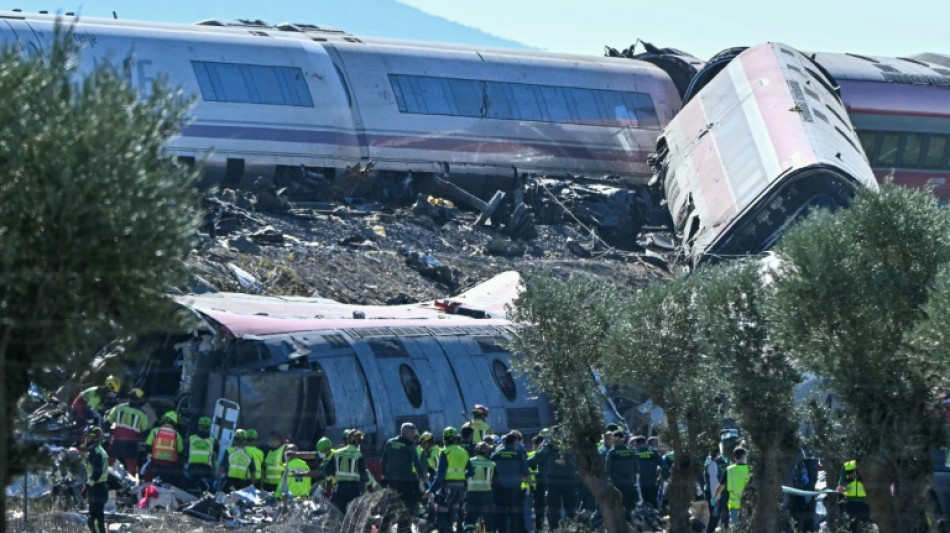
AFP reporters on the scene in the central region of Castilla-La Mancha saw one train embedded into another and some carriages lying on their side in tangles of metal debris at the bottom of an embankment.
Dozens of emergency services vehicles were racing to and from the site during a frantic search for survivors, while several black vans arrived from a funeral parlour.
Castilla-La Mancha's leader Emiliano Garcia-Page told reporters at the scene that 68 people had died, raising an earlier toll of 64 and having already warned of more victims being found.
A spokeswoman from the Castilla-La Mancha regional government told AFP that more than 100 people had been injured. Of them, 58 had been taken to hospital, with 15 in a critical condition.
State railway operator Renfe confirmed in a statement that the main high-speed line from Madrid to southern Spain had been suspended after one of its services suffered an accident with a train from private Spanish company Iryo.
- 'Chaos' -
Pablo Mejia, 42, with blood staining his grey jumper, told AFP that he had miraculously survived after changing his seat, as he awaited a transfer to the southern city of Seville.
He recounted "a very strong hit. It lasted a long time until it stopped, lots of people on the floor, on top of each other, seats ripped out, suitcases, a lot of chaos."
A visibly shaken Manuel Ortiz who lives in the village of Urda close to the site of the accident, around 130 kilometres (80 miles) south of Madrid, told AFP he had been transporting survivors all morning in his car.
Ortiz, 49, described a "horrific, horrible" scene that "smelled of an accident, of metal".
Transport Minister Oscar Puente told reporters that the collision came after a train was ordered to go in "error" despite a technical failure affecting the automatic control system that halted all services on a 69-kilometre stretch of track.
"The decision to resume traffic, while that system had not been restored, belongs to the control centre," which resumed traffic "in circumstances that, from our point of view, are inexplicable", Puente said.
The Renfe train restarted and travelled 25 kilometres until it collided with the stationary Iryo, at a speed that could have reached "up to 200 kilometres per hour", Puente added.
The control centre "had more than enough time to verify the error, and they did not fix it", Puente said.
- Rail safety under scrutiny -
The accident comes one month before Socialist Prime Minister Pedro Sanchez, who faced heavy criticism for this year's first disaster, seeks to overturn unfavourable polls and extend his eight-year premiership in an early general election on November 29.
He said Spain would observe three days of mourning from Thursday, conceding it was "not acceptable" that two high-speed collisions could happen within months. His Socialists halted campaign activities.
The leader of the main opposition conservative Popular Party, Alberto Nunez Feijoo, who leads in most polls, also suspended campaigning but said: "Spain has the right to know what is going on with its infrastructure."
Condolences flooded in from across Spain and Europe. The Spanish royal household said on X it was "shocked and concerned" by the accident, conveying its support to the victims, their loved ones and the emergency services.
Spain's high-speed rail network has received huge investment in recent years, growing to become the second-largest in the world after China's and a source of national pride.
But Wednesday's accident comes after another collision between two high-speed trains outside the southern village of Adamuz in January left 46 dead, which raised major questions about safety on the country's railways.
That crash was Spain's deadliest train accident since 2013, when 80 people died after a train veered off a curved section of track outside the northwestern city of Santiago de Compostela.
K.Willems--JdB