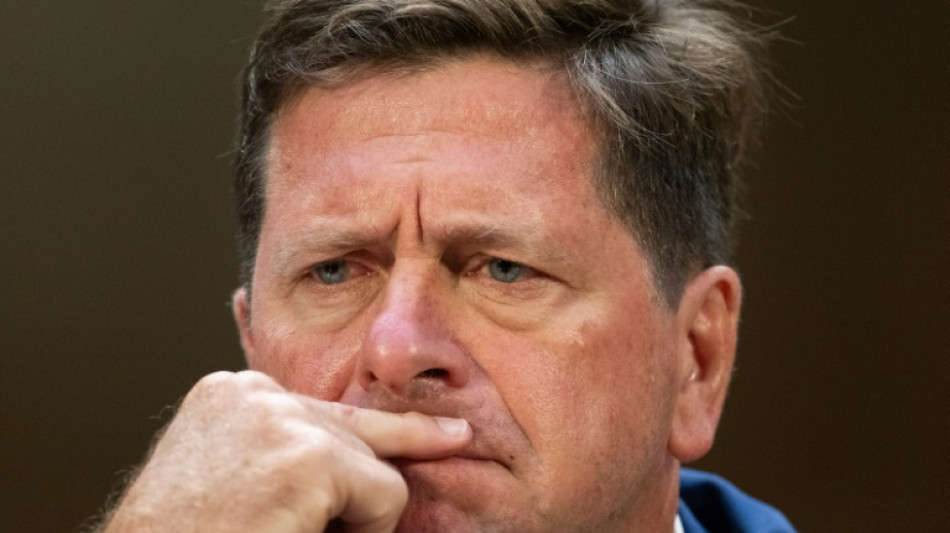
Spy chief Clayton, the Trump loyalist tech bosses trust on AI / Photo: Aaron Schwartz - GETTY IMAGES NORTH AMERICA/AFP
Jay Clayton, Donald Trump's pick for AI czar, is the nation's top spy, and a rare figure trusted by both the president and the tech bosses determined to keep the AI boom roaring.
The 60-year-old lawyer, who will keep his post as director of national intelligence, is unlikely to question the central place of artificial intelligence in the US economy, even as opposition to the technology grows among American voters.
"Jay Clayton is a golden asset for the administration because he's so well respected by tech leaders as well as many in the government," said Dan Ives of Yorkville Ives & Co, an investment company.
"He is not a typical Beltway bureaucrat," Ives added, calling the appointment "bullish for the industry because you can't just have a regular political appointee."
A regular golf partner of Trump, Clayton entered politics when Trump picked him to lead the Securities and Exchange Commission, the national markets regulator, in 2017.
A longtime Wall Street lawyer at Sullivan & Cromwell, where he represented Goldman Sachs during the 2008 financial crisis, Clayton ran the market regulator without ruffling feathers. He brought cases against crypto companies, an industry that has since become closely aligned with Trump and his family.
His wife, Gretchen Butler Clayton, worked as a wealth manager at Goldman Sachs but stepped down when he joined the government in 2017.
- No David Sacks -
Trump picked Clayton to lead the US Attorney's Office for the Southern District of New York at the start of his second term, where he took on cases dear to the president, including a probe ordered by Trump into ties between prominent Democrats and the late sex offender Jeffrey Epstein.
His office also signed off on controversial subpoenas against New York Times reporters days before his confirmation hearing for the intelligence post. The Senate confirmed him in July.
But Clayton is no David Sacks, the Silicon Valley venture capitalist who held the AI role at the start of Trump's second term.
Clayton has no technology background, but does hold an engineering degree from the University of Pennsylvania, where he also earned his law degree, as well as an economics degree from the University of Cambridge.
"Jay Clayton doesn't have the same deep background in technology that Sacks brought to the role, but he has a rich federal resume and significant experience navigating the federal bureaucracy," said Aalok Mehta of the Center for Strategic and International Studies.
"He also seems to be highly in sync with the president's thinking right now -- though of course we have seen plenty of examples of other advisors that started out that way but ultimately fell out of favor," Mehta added.
Carl Tobias, a law professor at the University of Richmond, said juggling two major jobs would be a challenge, though Trump has handed multiple roles to trusted officials in his second term, including Secretary of State Marco Rubio and Treasury Secretary Scott Bessent.
- National security -
"Jay Clayton ultimately is going to have to do what the president wants," said Connor Martin, a national security fellow at the Council on Foreign Relations.
But by giving the AI portfolio to the nation's top spy, Trump seemed to be accepting arguments that the technology poses real dangers for cybersecurity and is key to the geopolitical rivalry with China, he added.
A tech industry source in Washington said the industry largely welcomed the appointment, but cautioned against expecting major change.
"Jay Clayton is not going to preside over some big regulatory effort," the source said. "If he brings coherence to the policy, or provides details that bring clarity, those would be wins."
Clayton will not be the only voice in Trump's ear on AI, however.
Sacks, along with tech bosses including Nvidia's Jensen Huang and Meta's Mark Zuckerberg, will continue to hold significant sway over how the president approaches the industry.
Elon Musk is also back in Trump's good graces after their falling out in 2025.
Clayton takes on the role days after tech bosses signed a commitment at the White House to self-police their AI models, an accord Trump called "morally binding."
Mehta said he expected Clayton to coordinate the government more effectively while sticking to Trump's goal of not slowing the industry.
"But at the same time, the problems he is facing -- like around AI safety and sentiment -- are bigger and harder now, and they are happening at a much faster clip," he said.
S.Lambert--JdB