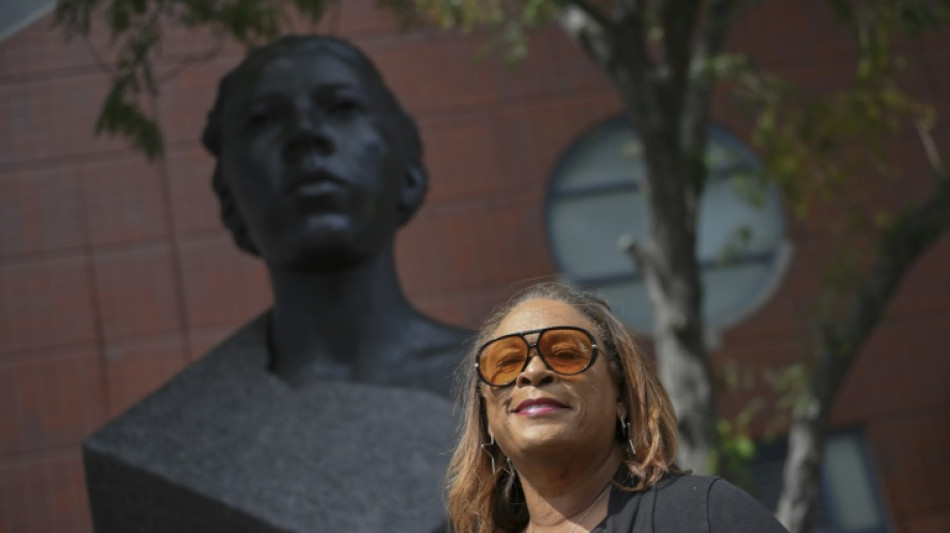
Gauff salutes Zina Garrison, 'pioneer' in Black tennis / Photo: ANGELA WEISS - AFP
Zina Garrison has known of Coco Gauff for some time, but she only met the 2023 US Open champion last year and "it was literally a handshake," Garrison told AFP.
So Garrison, a former world number four who is often remembered as the 1990 Wimbledon finalist, was surprised when she was contacted about a documentary to be executive produced by Gauff, who was born eight years after Garrison retired in 1996.
"It was kind of like, 'Oh, really?,'" said Garrison, who became "really excited" as she learned more.
US Open semi-finalist Gauff calls Garrison "a pioneer for moving the needle in tennis from a cultural standpoint," she said at the start of the film.
"Without her, we don't have me for sure," said Gauff, whose grandmother was the first Black student in a Palm Beach, Florida high school in the early days of desegregation.
The 62-year-old Garrison, a US Open semifinalist in 1988 and 1989, is back on the grounds of Flushing Meadows again this year to commentate for US Open Radio.
Garrison was in the booth Wednesday to watch as Gauff saved two match points before scraping past Russia's Mirra Andreeva to reach the last four.
"I am worn out. I am loving it," Garrison said as Gauff pulled even after an error-strewn first set. "This is what tennis is all about."
The year after Garrison's exit from professional tennis, 17-year-old Venus Williams reached the finals of her first US Open in 1997, the same year the tournament unveiled Arthur Ashe Stadium.
Garrison has long had a close relationship with both Venus and Serena Williams, who were on the practice court keeping tabs in July 1990 when Garrison played Martina Navratilova in the Wimbledon final.
"'Did she win'?" the sisters demanded of their father, said Garrison, who has been told the anecdote by both Venus and Serena, who were 10 and eight at the time.
Garrison captained the sisters for the US team on Fed Cup and also guided Serena under a WTA mentoring program.
Both Garrison and Serena are youngest siblings and both are "hyper emotional," although Serena is more extroverted, said Garrison, who calls herself "a big introvert."
- Proving 'we belong' -
There were other accomplished Black players when Garrison joined the tour in the early 1980s, including France's Yannick Noah, who won the French Open in 1983.
But Garrison was the first African-American since Arthur Ashe to consistently reach the second week of Grand Slams. She also won two medals at the 1988 Olympics, including a gold in women's doubles with Pam Shriver.
Her greatest run came at Wimbledon in 1990 when she beat both Monica Seles and Steffi Graf before falling to Navratilova. The match -- the first Grand Slam final with a Black American player since Ashe's Wimbledon win in 1975 -- transcended the sport.
"People were interested in tennis that normally would have never been interested in tennis per se. Black, white, mixed. Everyone," Garrison recalled. "Because it was different, and I was different."
Both Ashe and Althea Gibson, the first African-American player to win Grand Slams, were in attendance for the match, which turned out to be the apex of Garrison's career. It came after Garrison upset Navratilova at the 1998 US Open and beat Chris Evert the next year in the American great's final Grand Slam match.
More than any match, Garrison remembers feeling like "I was having to prove something to myself, but also prove something to the world, that we belong," Garrison said.
"And what I mean by 'we belong' is like Black Americans, were able to sell products to other people, you know, because I was told so many times that we weren't."
Before that Wimbledon, Garrison stood out among top players in not having a clothing contract. On the eve of the Wimbledon final, she signed a deal with Reebok, wearing the attire for the final.
After the Williams sisters' triumphs, brands have been eager to showcase today's African-American stars including Gauff, Frances Tiafoe and Ben Shelton.
Garrison welcomes this evolution but notes that tennis still prices out too many people.
"There are a lot more people who are doing a lot of great things in the world of tennis," she said. "But overall, it's still a very wealthy sport. It's a sport that not many, whether you're black, white, or Hispanic, at this point, can afford to play."
Garrison who spoke with Ashe about the need to "pass on the wisdom" to younger generations, now works for the city of Houston's parks department on youth sports development where she leads tennis programs.
"I don't have any regrets," she said. "I believe that that time for me was when I was supposed to come up."
E.Janssens--JdB