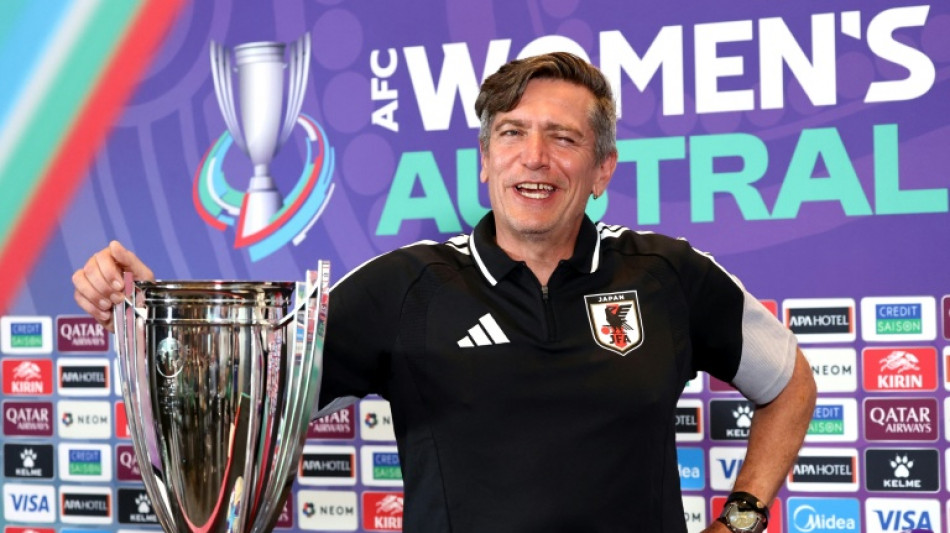
Culture clash spelt shock end for Japan women's first foreign coach / Photo: DAVID GRAY - AFP
Nils Nielsen's shock exit as Japan coach after leading them to Women's Asian Cup glory was partly down to communication issues and cultural differences, officials and experts said.
Greenlander Nielsen took a rampant Japan to their third Asian title in four tournaments, beating Australia 1-0 in the final in Sydney on March 21.
The 54-year-old -- the first foreign coach of the Japan women's team -- was unceremoniously dumped less than two weeks later.
The Japan Football Association said Thursday that his contract had expired and they had not offered him a new one.
Women's national team director Norio Sasaki argued that Japan could not win next year's World Cup if Nielsen remained in charge, describing his coaching as "a little too lax, a little too soft".
Kazuhiro Ishii, a journalist who has covered women's football in Japan for 20 years, told AFP that rumours that the JFA were not satisfied with Nielsen began to surface late last year.
But he said he was still "shocked" by the sudden departure of a coach who had led Japan to 12 wins, four draws and four defeats since taking over in December 2024.
"I had heard vague talk that there was a possibility he might leave," Ishii said.
Japan scored 29 goals and conceded just one in winning the Asian Cup in style.
Nielsen appeared to have a good relationship with his players and employers, and stressed how much he enjoyed working with them after returning from Australia.
"You guys here in Japan have a very charming team, very well behaved, great sportsmanship, fantastic talents, and that was shown in the matches," he said.
Behind the scenes, Japanese football chiefs were preparing to pull the plug on Nielsen, who previously served as technical director of Manchester City's women's side.
Team director Sasaki said there was a communication issue between Nielsen and his players, even though 16 of the Asian Cup squad were based in England.
Sasaki said that Nielsen's Japanese assistant coach Michihisa Kano had begun to assume more responsibilities in training after a poor run of form late last year.
Kano has now been put in interim charge for three friendlies against the United States this month, and Sasaki said the next full-time coach would likely be Japanese.
- Outsized influence -
Football journalist Masafumi Mori said communication was "an issue that always comes up when you have a foreign coach".
"The culture is different, and I think that's a problem Japan has constantly had to deal with in the past," he said.
Nielsen also had to contend with the presence of Sasaki, who coached Japan to World Cup glory in 2011 and remains a towering figure in Japanese women's football.
Nielsen said the pair had a good working relationship and that he was "lucky to have a person like Sasaki-san to help us out".
"You have a tendency as a coach or as a technical staff to lose your way a little bit in details, and the picture needs to be seen by somebody observing from the outside," Nielsen said after the Asian Cup.
Journalist Ishii said the Japan women's team do not enjoy the same level of dedicated organisational support within the JFA as the men's team do.
As a result, he said "Sasaki's personal opinions tend to be reflected heavily" in the decision-making process.
"I feel that's a major part of the problem this time," said Ishii.
Whoever succeeds Nielsen has just over a year to prepare for the World Cup in Brazil, with Japan looking to go past the quarter-finals for the first time since 2015.
Defeats to Brazil, Spain and Norway under Nielsen last year showed there is still much work to do.
"I can't say for sure either way, but personally I think it would have been better to continue with Nielsen," said Ishii.
"I don't foresee some great coach with a tremendous track record coming in and dramatically improving things."
R.Vercruysse--JdB