Merz Warns of Omnipresent Anti-Semitism in Germany on Kristallnacht Anniversary
German Chancellor Friedrich Merz warned that open Jewish life in Germany is no longer possible, pointing to the necessity of armed guards outside synagogues as evidence of persistent hostility. Speaking on the anniversary of Kristallnacht, Merz highlighted a surge in anti-Semitic incidents and urged citizens to confront hatred rooted in criticism of Israel.
German Chancellor Friedrich Merz declared that open, visible Jewish life in Germany remains impossible, citing the presence of armed guards outside synagogues as a stark indicator of persistent hostility. Speaking at Munich’s Ohel Jakob Synagogue on Monday, November 9, Merz warned that Jew-hatred has become "omnipresent" across the country and its European neighbors.
Standing inside the synagogue, which shares its name with a nearby house of worship destroyed during the Nazi pogrom of Kristallnacht 88 years earlier, Merz described anti-Semitism as a force manifesting in streets, schools, parliaments, and associations. He noted that this hatred is often disguised under the guise of anti-colonial liberation struggles or criticism of Israel, sometimes justified through what he termed a distortion of history.
Among those present was Charlotte Knobloch, president of the Jewish Community of Munich and Upper Bavaria. At 94 years old, Knobloch was six years old during the November 9-10, 1938 pogrom, when synagogues were burned, Jewish homes ransacked, and Jews murdered across Germany and Austria. Merz addressed her directly, acknowledging that she experienced "what no human being—and what no 6-year-old child... should ever have to experience."
Merz quoted the biblical verse from the Book of Numbers, "How beautiful are your tents, O Jacob, your dwelling places, O Israel," which serves as the namesake for the Ohel Jakob Synagogue. He contrasted this verse with the reality faced by Jews during Kristallnacht, asking how such words would have sounded to those awakened by armed squads breaking into their homes with stones, axes, and gasoline canisters.
The Chancellor invoked the millions of Jews subsequently arrested and deported to concentration camps, questioning how the psalm would have resonated with those sent to "hell on earth." He emphasized that Germany is currently living through a time of renewed historical upheaval, presenting a test of the nation's commitment to the principle of "never again."
Data supports Merz’s concerns regarding rising hostility. According to the Berlin-based Federal Association of Departments for Research and Information on Antisemitism, Germany recorded a record 8,725 anti-Semitic incidents in 2025, an increase from 8,627 in 2024. This figure is more than triple the 2,480 incidents recorded in 2022. The 2025 total included 178 assaults and 257 cases involving threats. Jew-hatred related to Israel accounted for 68% of all incidents.
Merz specifically addressed the surge in anti-Semitism following the October 7 Hamas-led attacks on southern Israeli communities, describing those events as barbaric. He condemned the need for Jewish institutions in Germany to rely on extensive security measures, including high walls, bulletproof glass, and armed guards.
"An institution with police officers standing outside may be secure—yes, probably. But it is also a horrifying sight," Merz said. "High walls, bulletproof glass, armed security personnel outside Jewish institutions: These are constant reminders that normal, open, visible Jewish life in Germany is still not possible."
The Berlin association documented 2,787 anti-Semitic incidents between October 7 and the end of 2023, averaging about 33 daily compared to just over seven daily before the attacks.
Merz urged Germans to speak out against anti-Semitism, listen when Jews report it, and take an interest in Israel’s fate. He noted that historical research shows anti-Semitism often flares up during times of crisis and upheaval. Germany has long been marked by cycles of expulsion, persecution, and violence in its Jewish history.
As a federal government, Merz stated that Germany is doing everything within its power to protect Jewish life both domestically and globally. He affirmed that Germany stands "unwaveringly alongside Israel," adding that the existence of a state where Jewish people are not a vulnerable minority in need of protection is part of Germany’s historical responsibility.
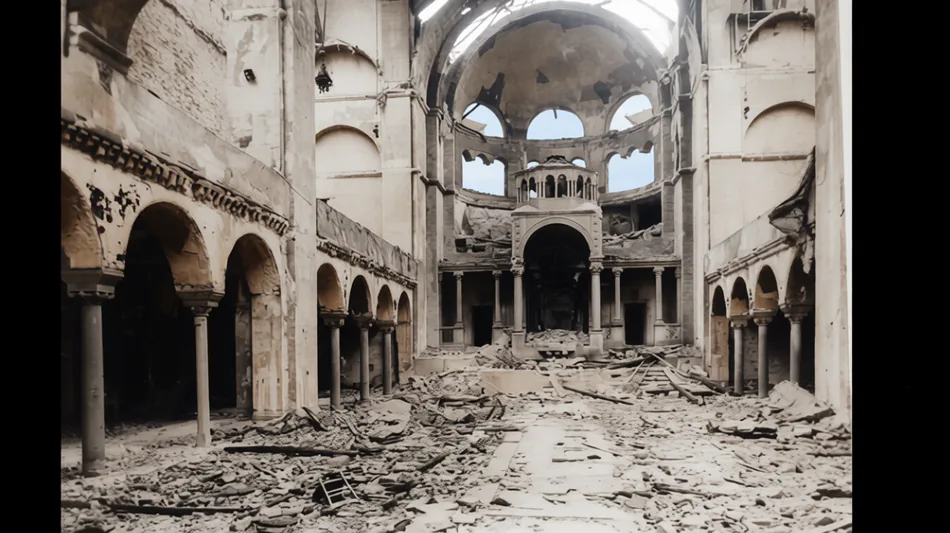
The speech took place at the Ohel Jakob Synagogue, located in Munich. The event was accompanied by archival imagery of the destroyed Fasanenstrasse Synagogue in Berlin, which was burned during Kristallnacht in 1938. This image served to illustrate the historical context of the anniversary rather than the specific location of Merz’s address.
Merz’s remarks highlighted the ongoing tension between Germany’s efforts to protect its Jewish population and the persistent threat of anti-Semitism fueled by regional conflicts. The Chancellor’s warning underscored the challenges faced by Jewish communities in maintaining a visible presence in public life amidst rising hostility.
J.F.Rauw--JdB