Kyiv's desperate vendors persevere outside obliterated flea market / Photo: Tetiana DZHAFAROVA - AFP
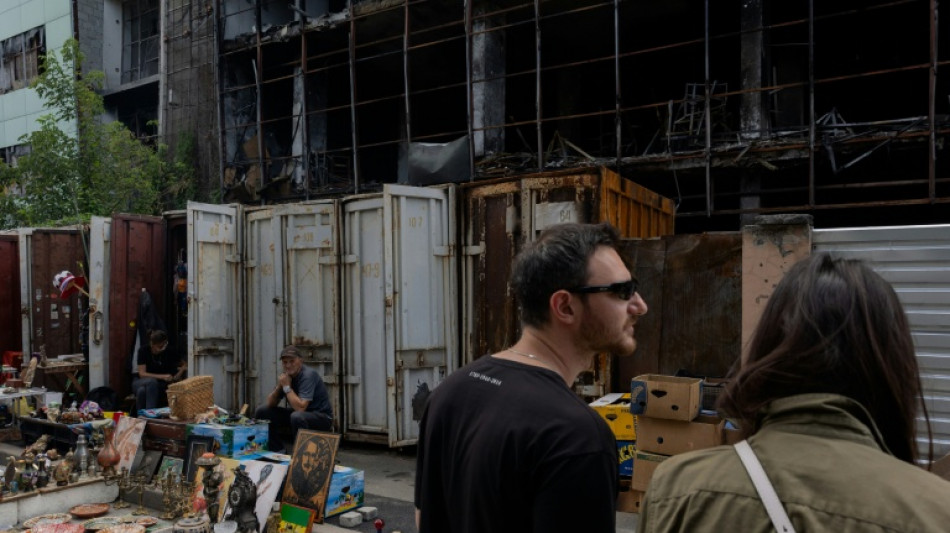
On the scorching asphalt besides what was once a bustling Kyiv flea market, vendors were trying to sell the remains of their stock, ravaged by a Russian missile strike.
Moscow destroyed the popular Pochaina site in the north of the Ukrainian capital in a major attack last month -- the third on the market since Russia invaded in February 2022.
Shards of glass and porcelain crunched under Vadym's feet as he walked through the remains of his shop.
Prized vinyl records and vintage audio equipment are nothing more than a blank mush, speckled with ashes and broken pieces.
"There were four Led Zeppelin autographs and a Jim Morrison autograph," Vadym said.
"This is a Tour de France original bicycle," from 1979, the 73-year-old added, holding up a piece of a rusted frame.
A well-known institution in Kyiv, the market moved to a permanent building in the early 2010s, where vendors rent small spaces or containers.
Informal street sellers would bustle nearby to catch passing trade.
The site is now a hunk of twisted and blackened metal, surrounding a charred carcass of rubble.
Now all the vendors who still have anything worth selling have been forced on to the street.
- 'Trying to survive' -
At least six Kyiv markets have been damaged or destroyed since Russia invaded in 2022, according to an AFP tally.
A similar scene plays out every day at the central Lukyanivka market.
A handful of sellers gather in front of the burnt-out shell offering tomatoes, cheese and cured meets on makeshift tables.
And last weekend another Russian strike set a major book market ablaze, scorching thousands of volumes and leaving charred pages across the streets.
Visiting the Pochaina flea market 10 days after the Russian attack, AFP journalists could still smell the mix of burnt metal and plastic hanging in the air.
Some customers were still coming by, hoping to unearth a rare gem amid the clothes, records, dishes and other items.
A woman approached the stall where Vadym and his wife, who sells porcelain, had laid out what they had left, and asked the price of an elegant lamp with a cream-coloured shade.
"Tearing our hair out and burying ourselves in the ground -- that's not our way. We are optimists," Vadym, who declined to give his surname, told AFP.
Victoria, a 36-year-old genealogist, was visiting the market for the first time.
"People have lost their businesses, and I would also like to support some of them. Every person is simply trying to survive, and every business is trying to survive," she told AFP.
Her own finances have deteriorated amid the economic pressures of the war.
- 'Melted glass' -
Svitlana, 63, saw half her stock of vintage bags and dishes destroyed in an earlier Russian strike on the market.
The latest one left her with nothing but "puddles of melted glasses."
"We are almost left without any means of livelihood, because we don't receive a salary anywhere ... we are self-employed," she said.
"We want to restore everything, but I don't know how much we'll be able to," she added.
The plastic table she has set up to try to sell a few last items brought from home, and the umbrella shielding her from the relentless sun, were bought with donations.
She has filled out a government form demanding compensation from Russia -- a bureaucratic formality.
Vendors have little hope that the market will be rebuilt before the end of the war.
Russia is striking Ukraine on a daily basis, killing hundreds of civilians every month and pushing millions into poverty.
Diplomatic efforts to end the war are at a standstill.
Sitting in the shade, Oleksandr was looking over his goods -- paintings, electronic components, toys and old phones -- laid out on wooden blanks on the tarmac.
There are "ten times fewer" customers now, he said.
"The people who used to collect things, stock up on things, or take an interest in things are gone," he added.
"Now food is the priority."
K.Laurent--JdB