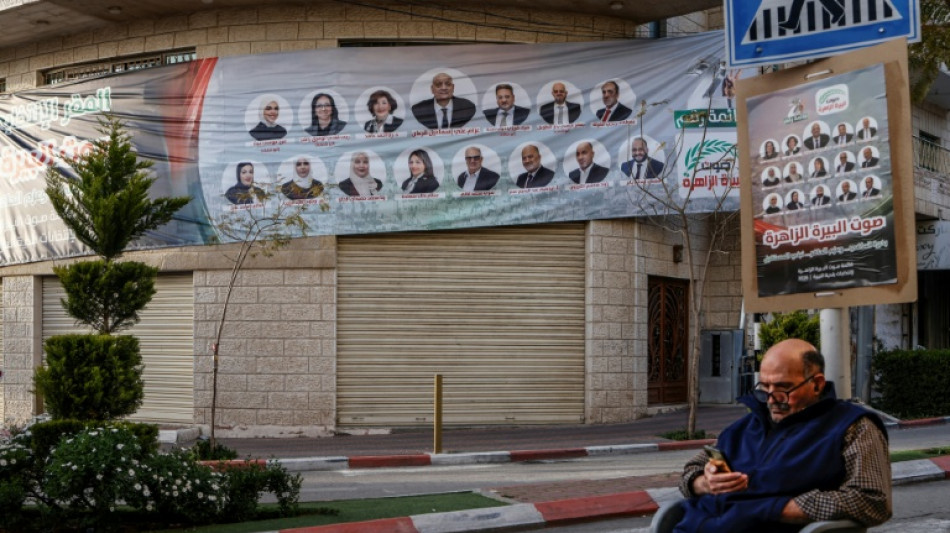
Little enthusiasm as Palestinians gear up for local polls / Photo: Zain JAAFAR - AFP
With local elections due next week, West Bank Palestinians are struggling to muster enthusiasm for their first ballot since the Gaza war, discouraged by limited political choice and the difficulty of voting under Israeli occupation.
On April 25, voters will choose representatives in cities, towns and villages across the West Bank, with the ballot happening in part of the Gaza Strip in the first such election since the start of the war there in October 2023.
Nearly 1.5 million people are registered to vote in the occupied West Bank, as well as 70,000 people in Gaza's central Deir el-Balah area, according to the Ramallah-based Central Elections Commission.
But many have been disappointed by a new electoral law passed by decree by Palestinian president Mahmud Abbas requiring all candidates to agree to the Palestine Liberation Organisation's charter and goals in order to register.
"The issue of agreements related to the PLO? I don't agree with this at all," said Khomini Suleiman, a car parts dealer from Beit Ur village near Ramallah, who said he would not vote.
Although some candidates said the new rules had prevented them from running, observers pointed to a general narrowing of the political field.
"The truth is that political parties have effectively disappeared from the Palestinian political scene," a Palestinian elections expert told AFP, speaking on condition of anonymity because of the sensitivity of the issue.
Ramallah resident Mohammad al-Taj said he was a "proud" PLO member but did not think recognition of the charter and programme of the organisation -- which has recognised Israel since the 1990s -- should be a condition for running for office.
But he said he would not vote anyway with the difficulties caused by Israeli settler attacks and the occupation making local elections of "secondary" importance.
Although the Palestinians have regularly voted in local elections, the last time they held parliamentary elections was in 2006, when the Islamist Hamas won a sweeping victory over Abbas's Fatah movement.
Abbas, who is now 90 and has remained in power for more than 20 years without ever being re-elected, frequently promises legislative and presidential elections that have never taken place.
- No Hamas lists -
Most electoral lists are aligned with Abbas's Fatah or running as independents.
There are no Hamas-affiliated lists.
"Hamas and Hamas-affiliated candidates are just staying out of it," the elections expert said.
Aref Jaffal, another Palestinian expert, said there were some "positive sides" to the new law that lowers the candidacy age to 18 and hikes the women's quota to 25 percent.
But he deplored the fact it transferred some municipal powers to the local government ministry, thereby empowering Abbas's ruling Palestinian Authority.
In most cities, Fatah lists will run against independent lists headed by candidates from factions such as the Popular Front for the Liberation of Palestine (Marxist-Leninist).
But in many cities, including Ramallah, the seat of the Palestinian Authority, only one list has been submitted, meaning it wins automatically without needing a vote.
Raeda Barghouti, 49, said she was excited because her village, Kobar, would be voting for the first time in a decade, since in previous elections there was only one candidate list.
- Gaza experiment -
In Hamas-run Gaza, the PA is holding elections only in Deir el-Balah "as an experiment (to test its own) success or failure, since there are no post-war opinion polls", Jamal al-Fadi, a political scientist at Cairo's Al-Azhar University, told AFP.
Deir el-Balah was chosen as it was one of the only places in Gaza where "the population has remained largely in place and not been displaced" by more than two years of war with Israel, he said.
The election commission says it has recruited polling staff from civil society organisations and hired "a private security company to secure polling centres" for the Gaza vote, spokesman Fareed Taamallah told AFP.
Although a truce deal halted the fighting in October 2025, nearly half of Gaza remains under Israeli control with Palestinians killed by Israeli troops on a near-daily basis.
Asked about coordination with Israel or Hamas, Taamallah said the commission was indirectly coordinating with COGAT, the Israeli defence ministry body in charge of Palestinian civilian affairs, but with "no other party".
The commission said voting would not take place in Israeli-annexed east Jerusalem as Israeli authorities forbid Palestinian political activity in the city.
B.A.Bauwens--JdB