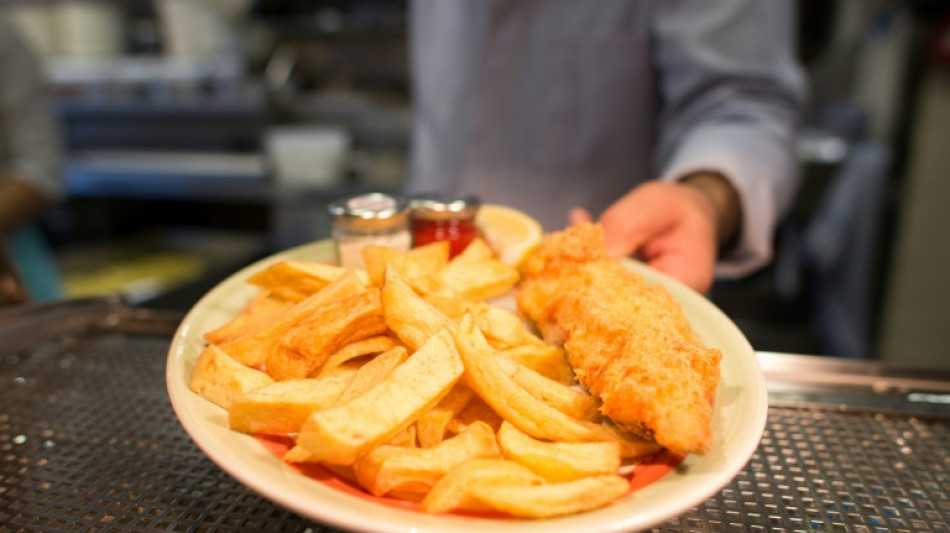
Middle East war hits Britain's fish and chip shops / Photo: LEON NEAL - AFP/File
Before war erupted in the Middle East, fisherman Peter Bruce spent about £5,000 ($6,600) on diesel to trawl the North Sea for haddock and cod, the main species used in fish and chips.
"Now, the last trip we spent about £10,000," he told AFP, despite his crew reducing the speed of the boat to save fuel.
Bruce, whose boat, Budding Rose, is based in the Scottish port of Peterhead, estimates the extra costs over a year could exceed £100,000.
It was not yet clear whether the rise in energy prices would have an immediate effect on the price of fish, Bruce said. But he is worried that the hike in fuel prices will hit customer demand for the classic British meal that was already facing challenges on numerous fronts.
Bruce's catch is sold at auction in Peterhead before being transported around Britain and abroad. He fears that customers "will stop buying so much fish and chips and they'll stop going out for meals so much".
- Classic dish -
The classic recipe for fish and chips -- white fish deep-fried in batter, chips, and mushy peas, often with tartare sauce on the side -- dates back to the 1860s.
Fish and chip shops usually serve nothing else and most are take-away.
There were around 10,500 fish and chip shops in the UK in 2024 -- roughly the same as a decade earlier -- according to Seafish, a public body supporting the industry.
This was more than the total number of outlets of the nine main fastfood dining brands -- including KFC, McDonald's and Domino's Pizza, it boasted.
Easter is a particularly busy time for the sector since many Britons eat fish on the Good Friday holiday.
Andrew Crook, who owns a fish and chip shop in Lancashire, northwestern England, told AFP the number of customers can more than double on Good Fridays.
Nonetheless, "we're definitely under pressure," said Crook, president of the National Federation of Fish Fryers.
He blamed several factors.
"We've got extremely high fish prices, we've got energy prices; wages go up continually," he lamented.
The war in the Middle East, now in its second month, caused a record monthly rise in petrol and diesel prices in the United Kingdom in March was caused by the conflict, according to data from the Royal Automobile Club (RAC), a British auto services company.
But there are other difficulties.
- Oil, fertiliser... -
Stricter fishing rules to conserve species, as well as the war in Ukraine -- Russia previously supplied 30 to 40 percent of the country's fish -- had weakened the sector in Britain already, says Crook, and forced it to raise prices.
Another concern is the soaring price of fertilisers and its impact on production of potatoes and oil seeds. Some 30 percent of the world's fertiliser normally passes through the Strait of Hormuz, which is now almost closed.
Back in 2022, small businesses were worried about a shortage of sunflower oil, since Ukraine was the world's leading exporter of the seeds; now, they are increasingly concerned about the energy cost of heating their cooking oils.
Crook, who sells fish and chips for £11.45 ($15) per portion, said businesses are looking at options to avoid putting up prices, such as choosing less costly fish species like pollack from North America and South African hake, and reducing portions.
"We do try to cushion consumers," he said, adding that he does not want to raise his prices for now.
T.Peeters--JdB