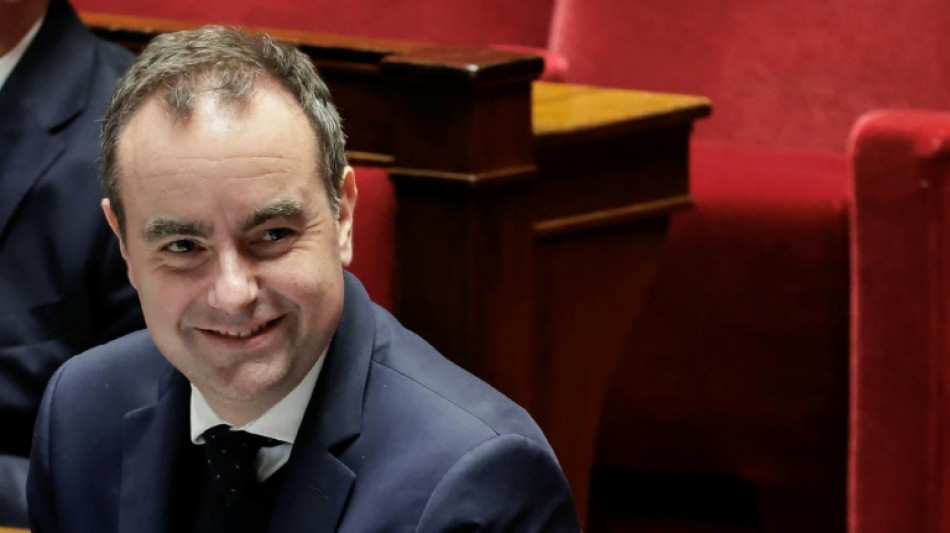
France poised to adopt 2026 budget after months of tense talks / Photo: STEPHANE DE SAKUTIN - AFP
France is expected to adopt its 2026 budget on Monday after months of fraught negotiations if Prime Minister Sebastien Lecornu survives the latest in a string of no-confidence motions.
The premier on Friday forced his budget through parliament without a vote for the third and final time, triggering another wave of motions from the hard left and far-right parties.
If Lecornu survives the challenges -- which are expected to be rejected on Monday evening -- the budget will move forward for final approval.
The motions follow four months of political deadlock over the budget that last month forced Lecornu into an about-face on his pledge not to force the budget through parliament without a vote, a decision he called a "partial failure".
But the 39-year-old premier is expected to survive the latest challenges after making concessions to gain the backing of the Socialists -- a key swing group in parliament.
- Deficit-cutting effort -
The bill aims to cut France's deficit to five percent of gross domestic product (GDP) in 2026 from 5.4 percent in 2025, after the government eased back from an earlier target of 4.7 percent.
The budget also includes higher taxes on some businesses, expected to bring in about 7.3 billion euros ($8.6 billion) in 2026, though the Socialists failed to secure backing for a proposed wealth tax on the super-rich.
The Socialists did, however, win several sought-after measures, including a one-euro meal for students and an increase in a top-up payment for low-income workers.
The plan also boosts military spending by 6.5 billion euros, a move the premier last week described as the "heart" of the budget.
- State spending row -
In December, lawmakers narrowly adopted the social security budget, part of the broader spending plan, postponing an unpopular pensions reform until January 2028, after President Emmanuel Macron's term ends.
But they failed to reach a compromise on state expenses, complicated by a tug-of-war between a right-leaning Senate pushing for savings and a hung lower house where the left has demanded more tax income.
France is under pressure from the EU to rein in its debt-to-GDP ratio -- the bloc's third-highest after Greece and Italy -- which is close to twice the EU's 60-percent ceiling.
The country has been bogged down in political crises since Macron called a snap poll in 2024, in which he lost his parliamentary majority.
Lecornu was named premier in September -- then renamed the following month having stepped down -- after his two predecessors were both toppled by parliament over cost-cutting measures.
R.Michel--JdB