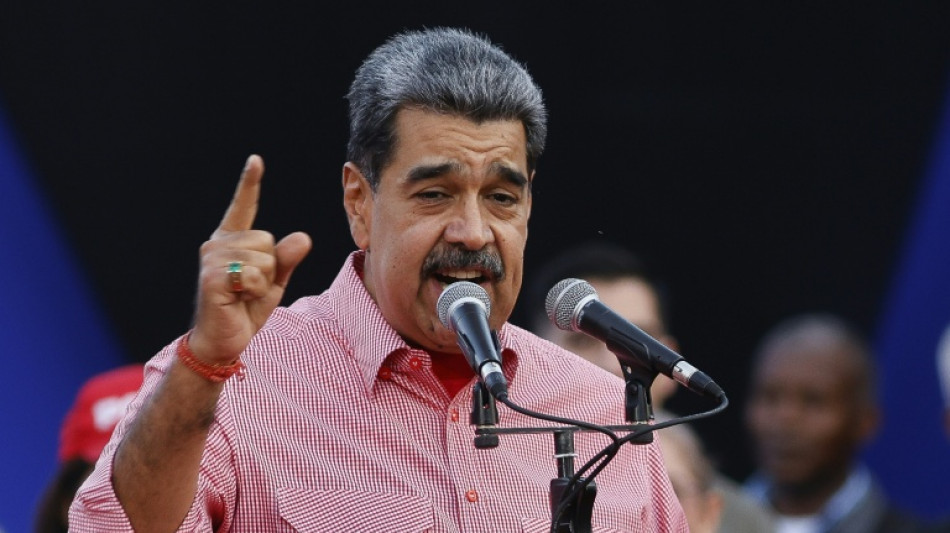
Maduro elusive on US attack, open to dialogue / Photo: STRINGER - AFP/File
President Nicolas Maduro Thursday dodged a question about an alleged US attack on a dock in Venezuela but said he was open to cooperation with Washington after weeks of American military pressure.
"Wherever they want and whenever they want," Maduro said of the idea of dialogue with the United States on drug trafficking, oil and migration in an interview on state TV.
Maduro's government has neither confirmed nor denied what President Donald Trump announced Monday: a US attack on a docking facility that served Venezuelan drug trafficking boats.
Asked point-blank if he confirmed or denied the attack, Maduro said Thursday "this could be something we talk about in a few days."
The attack would amount to the first known land strike of the US military campaign against drug trafficking from Latin America.
Trump on Monday said the United States hit and destroyed a docking area for alleged Venezuelan drug boats.
Trump would not say if it was a military or CIA operation or where the strike occurred, noting only that it was "along the shore."
"There was a major explosion in the dock area where they load the boats up with drugs," he told reporters at his Mar-a-Lago resort in Florida.
"So we hit all the boats and now we hit the area, it's the implementation area, that's where they implement. And that is no longer around."
In the interview, Maduro insisted that Venezuela has defended itself well as the US carried out its military campaign at sea.
"Our people are safe and in peace," he said.
Colombian President Gustavo Petro fueled rumors about the location of the attack, saying "Trump bombed a factory in Maracaibo" where "they mix coca paste to make cocaine."
That led some to speculate on social media that a fire at wholesale chemical distributor Primazol's warehouses in Maracaibo may have been related to the attack.
Primazol chief Carlos Eduardo Siu denied those rumors, saying "President Petro, not here -- we neither package nor manufacture any kind of narcotics."
- Unpleasant evolution -
Maduro said he has not spoken to Trump since a conversation they had on November 12, which he described as cordial and respectful.
"I think that conversation was even pleasant, but since then the evolution has not been pleasant. Let's wait," he said.
"If they want to talk seriously about an agreement to fight drug trafficking, we are ready," the Venezuelan leader said.
The Trump administration has accused Maduro of heading a drug cartel and says it is cracking down on trafficking, but the leftist leader denies any involvement in the narcotics trade, saying the US seeks a coup because Venezuela has the largest known reserves of oil on Earth.
Washington has ramped up pressure on Caracas by informally closing Venezuela's airspace, imposing more sanctions and ordering the seizure of tankers loaded with Venezuelan oil.
For weeks Trump has threatened ground strikes on drug cartels in the region, saying they would start "soon," but this is the first apparent example.
US forces have also carried out numerous strikes on boats in both the Caribbean Sea and eastern Pacific Ocean since September, targeting what Washington says are drug smugglers.
The deadly maritime campaign has killed at least 107 people in at least 30 strikes, according to information released by the US military.
The administration has provided no evidence that the targeted boats were involved in drug trafficking, however, prompting debate about the legality of these operations.
International law experts and rights groups say the strikes likely amount to extrajudicial killings, a charge that Washington denies.
I.Servais--JdB