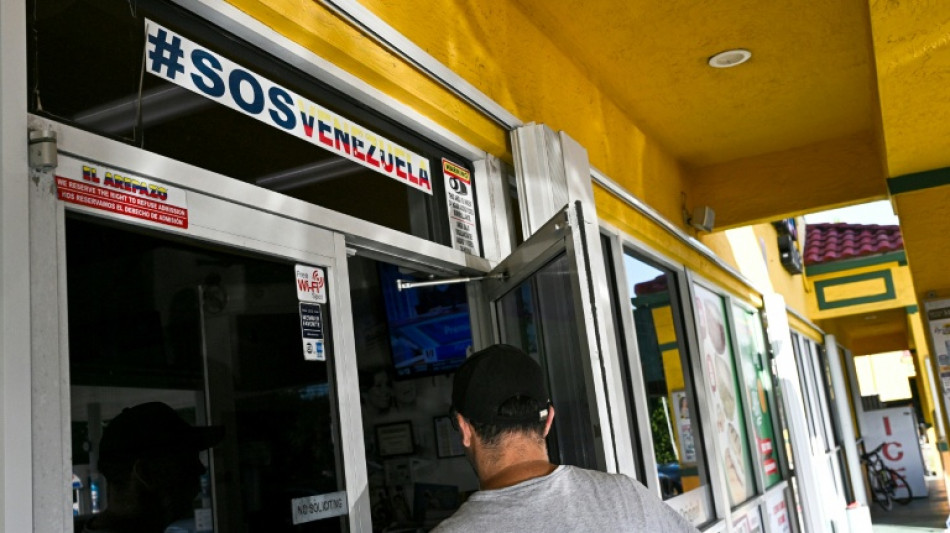
Florida's Venezuelans divided on US military buildup / Photo: CHANDAN KHANNA - AFP
As the United States deploys more military forces and carries out airstrikes on boats in the Caribbean, Venezuelans in South Florida are divided over what President Donald Trump's next moves should be.
Most people in the diaspora here long for a new leader to replace President Nicolas Maduro in Venezuela, a country that hundreds of thousands have fled amid economic and political crisis in recent years.
"If there's one common sentiment among all Venezuelans, it's the hatred we have toward Chavismo and Maduro," said Andrea Gonzalez, 38, referring to the left-wing ideology named for Maduro's predecessor, the late Hugo Chavez.
But differences arise over how to remove Maduro.
Some say force is the only option, especially after Maduro proclaimed himself president again in 2024 in elections that were deemed fraudulent by the opposition and other countries alike.
Others, fearful of the casualties of war, prefer to exhaust diplomatic avenues.
While the Trump administration has said it is targeting "narcoterrorists," many question the true motivation behind Washington's sudden military interest in the South American country with the most oil reserves on Earth.
Within the diaspora, Trump's image has been tarnished by his own immigration policy, which has cracked down on Venezuelans despite their overwhelming support for his pressure on Caracas.
In recent weeks, Washington has sent the world's largest aircraft carrier to the Caribbean, along with a fleet of warships, and Trump declared Venezuelan airspace "completely closed" for a supposed operation against drug trafficking.
Trump also said that operations "by land" to stop alleged drug traffickers were imminent.
- 'Double-edged sword' -
From Caracas, Maduro has long claimed Washington intends to overthrow him.
And in Doral, near Miami, where more than 40 percent of the population is of Venezuelan origin, Diana Gonzalez hopes that is the case.
The 47-year-old interior designer supports a "100 percent" intervention in her country to overthrow a government she accuses of being corrupt, stealing elections and repressing its opponents.
After years of unsuccessful peaceful attempts, that's the only viable option, she said.
"We can't go on alone because it's an unfair fight between people with flags and people with weapons," she said, adding that "no one in Venezuela will fight for the regime."
Regarding the future, she envisions a government led by Nobel Peace Prize laureate Maria Corina Machado, the opposition leader who is living in hiding.
But 66-year-old Carmen considers military intervention a "double-edged sword" for the country she left in 2020.
"If Maduro falls, it would be wonderful," she said, declining to give her last name. "But if that happens, there will be many deaths. A war between the two countries would be a catastrophe."
- Tensions -
Adelys Ferro, a Venezuelan activist for migrant rights, doubts the Trump administration's intentions for her country -- and tries to balance the personal with the political.
"In the midst of our desperation and desire for freedom, we have minimized what a war means," she said. "I can't put my desire to see my mother again above the lives of Venezuelans."
She believes if Washington wants change in Caracas, it should take advantage of the current pressures to force a peaceful transition. And she fears the consequences of a conflict for the country's inhabitants, including her mother.
In Doral, many prefer to avoid the topic and there is a reluctance to talking about Trump.
The mass arrests of Latino migrants promoted by his government and the revocation of Temporary Protected Status (TPS) granted to some 600,000 Venezuelans under previous president Joe Biden's administration have hit the community hard.
And that has created tensions.
Andrea Gonzalez, who supports Trump's initiatives in Venezuela but criticizes his immigration policies stateside, has experienced those tensions personally.
"There are people in your family who" say she should be happy about the immigration raids and the end of immigration privileges "because you voted for that person," Gonzalez said.
"Resentment is building among Venezuelans."
She believes, however, that Trump can regain ground in her community if he successfully overthrows Maduro.
"The same people who have been deported wouldn't hate him so much if he achieved that," she said.
W.Baert --JdB