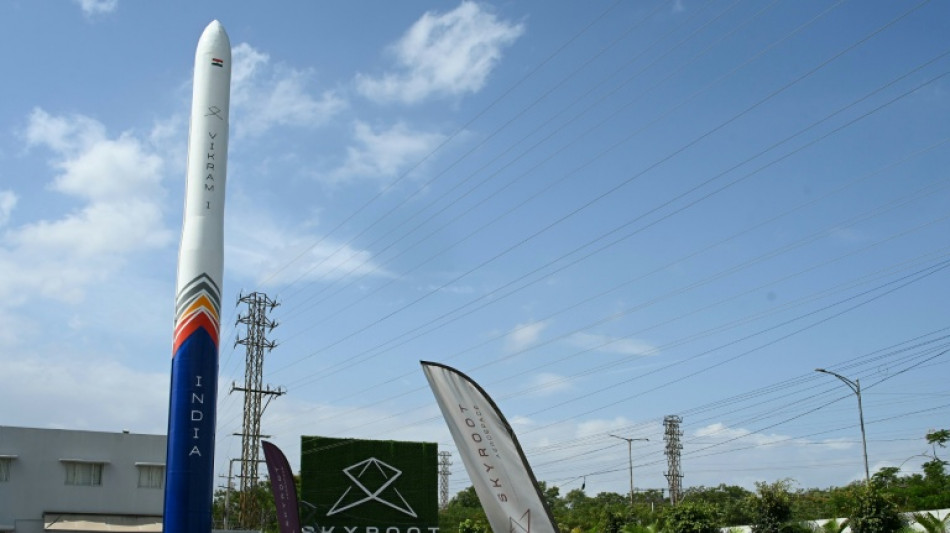
India's space sector takes off as private rocket readies launch / Photo: Noah SEELAM - AFP
India has sent spacecraft to Mars and the Moon, put hundreds of satellites into orbit and will in the coming days launch its first privately developed orbital-class rocket.
New Delhi's space economy -- valued at $8.4 billion -- has rapidly expanded since the sector opened up to private investment in 2020, attracting more than 400 space startups.
Several key government and private firms collaborating with the Indian Space Research Organisation (ISRO) also work on defence, creating increasing overlap between space and security.
But Skyroot Aerospace's plans to launch the country's first privately developed orbital-class rocket before August 4 mark the next major step for the growing Indian space industry.
"India is pursuing ambitious goals across deep-space exploration, space science, human spaceflight, and orbital infrastructure," the Department of Space said.
"These achievements reflect growing confidence, technological maturity, and a long-term vision for India's role in the global space ecosystem."
Here are some of those achievements and ambitions:
- Mars, Moon, Sun, Sea -
In 2014, India became the first Asian nation to put a spacecraft into orbit around Mars.
ISRO has also made strides with its lunar probe programme called Chandrayaan, or "Mooncraft" in Sanskrit.
The programme included a 2008 lunar orbiter, a failed 2019 landing attempt and a successful 2023 mission that deployed a rover.
The rover mission made India the fourth nation to land an unmanned craft on the Moon after Russia, the United States and China.
A fourth Chandrayaan mission set for 2027 is expected to bring back Moon samples, and a Venus orbit mission is slated for 2028.
An ongoing solar mission, Aditya, is observing the Sun's outermost layers and space weather.
On Earth, ISRO technology is helping develop India's Matsya submarine, named after the fish avatar of Hindu deity Vishnu.
It will carry scientists six kilometres (3.7 miles) underwater by 2027 to "harness deep ocean resources" including rare earth and critical minerals, according to Science Minister Jitendra Singh.
- Satellites -
Since ISRO built its first satellite that was launched on a Soviet rocket in 1975, India has garnered a reputation for cost-efficient missions.
Its space programme has accelerated since 2014, seeking a greater slice of the fast-growing commercial satellite market.
ISRO has launched more than 430 foreign satellites -- earning it more than $600 million -- and more than 144 of its own.
The country is expanding its launchpad at Sriharikota on the southeast coast in Andhra Pradesh, and a second spaceport is being built at Kulasekarapattinam in Tamil Nadu on India's southern tip.
New Delhi projects its space industry will grow to $44 billion by 2033 and $100 billion by 2040.
In addition to NASA, India works with the European Space Agency (ESA), France, Germany, Italy, Japan and Saudi Arabia. Its manned flight preparations are supported by Russia.
- Private players -
Alongside its broader technology and AI ambitions, India's private space industry is growing rapidly.
Leading firms include Skyroot Aerospace, which is readying the maiden test flight of the country's first privately developed orbital-class rocket.
The Vikram-1 rocket is designed to carry small satellites into low-Earth orbit and will lift off from Sriharikota sometime between July 12 and August 4.
Another company is Pixxel, which is building observation satellites for applications ranging from agriculture to environmental monitoring.
Bellatrix Aerospace is developing satellite propulsion systems, and Agnikul Cosmos is manufacturing small satellite launch vehicles powered by 3D-printed rocket engines.
- Military collaboration -
India's civil space and defence industries are deeply intertwined, with several government and private companies supplying both sectors.
That includes launch rockets, propulsion, satellite, electronics and guidance systems -- technology used in space and for India's growing missile and military drone programmes.
ISRO has praised the "active coordination" with the government's Defence Research and Development Organisation, and has had close ties with the BrahMos missile programme, a joint India-Russia venture.
Companies that supply avionics and guidance systems to ISRO are benefiting from a surge in military orders.
India has poured billions of dollars into defence procurement after its 2025 conflict with neighbouring Pakistan, where drones and missiles dominated the fighting.
- Manned mission -
ISRO is also planning its inaugural crewed mission, with the first of three expected uncrewed test runs slated for late 2026.
Named "Gaganyaan", or "sky craft", the effort aims to eventually send three Indian astronauts into a 400-kilometre orbit for three days.
As part of preparations, Indian Air Force pilot Shubhanshu Shukla joined the SpaceX Dragon spacecraft in 2025, becoming the first Indian to reach the International Space Station.
Prime Minister Narendra Modi has said India will have its own space station by 2035, and plans to send an astronaut to the Moon by 2040.
F.Dubois--JdB