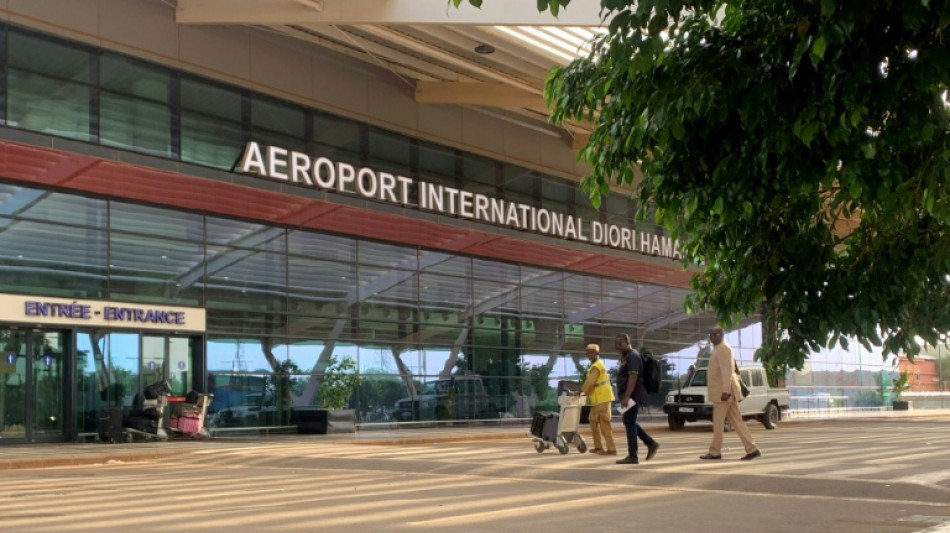
Al-Qaeda-linked jihadists attack Niger airport, 11 soldiers killed / Photo: - - AFP/File
A group linked to Al-Qaeda claimed Thursday's attack on the airport of Niger's capital, Niamey that killed at least 11 soldiers and two civilians, six months after other jihadists staged a large assault on the sensitive site.
Twenty-two attackers were also killed as security forces repelled the raid on the Diori Hamani International Airport in Niamey, Niger's defence ministry said.
Gunfire erupted early in the morning and rang out for hours near the airport, where a large military presence was later deployed, residents said.
In the evening, a brief statement from the Group for the Support of Islam and Muslims, or JNIM using its Arabic acronym, said it had carried out "a suicide attack" on the airport and on a neighbouring military base. The group is Al-Qaeda's Sahel branch.
Niger has been ruled for three years by a military junta, which has struggled to contain jihadist violence that has rocked the west African country for a decade.
"I heard the first shots around 6 o'clock (0500 GMT). The shooting was coming from the airport entrance," where there is a security checkpoint, a resident told AFP by telephone.
An airport source said the gunmen had arrived at the checkpoint "by taxi", then encountered "fierce resistance" from security forces.
The attackers -- some of whom wore explosive belts, according to the defence ministry -- were "dispersed in the surrounding neighbourhoods, where the security forces are carrying out vast sweeps", the airport source said.
Another resident, a motorbike-taxi driver, said locals were helping the security forces, "hunting down bandits with sticks and machetes".
In a statement read out on TV, the defence ministry said four people had been wounded in the attack and "about 20 suspects" arrested.
It said a large-scale army operation was under way and the "international airport, which is fully secure, remains open to air traffic".
But tracking site Flightradar24 indicated multiple flights bound for Niamey had been rerouted or delayed.
- 'Flaw in the system' -
In January, the airport and an adjoining military drone base were targeted in an attack claimed by the Islamic State in the Sahel (EIS).
Nigerien armed forces and their Russian allies repelled the strike.
Twenty assailants were killed and four soldiers wounded in the January 29 assault, authorities said.
The site is sensitive; between December and January, a large cargo of concentrated uranium from the key producer was blocked at the airport while waiting for export.
No movement of that cargo has since been identified.
As with the January attack, the Nigerien government blamed France, with the defence ministry describing the assailants as "armed mercenaries in the pay of Emmanuel Macron's France," referring to the French president.
It has regularly accused its former colonial power of financing jihadists to destabilise the country, an accusation Paris denies.
The head of Niger's junta, Abdourahamane Tiani, who seized power in a 2023 coup, said on state television "a flaw in the system" had enabled the January attack, whose aim, he said, was to "destroy" the army's air capabilities.
In recent weeks, the authorities have started tearing down thousands of illegally built homes near the airport in what they said were efforts to counter a "terrorist" risk.
They alleged the shantytowns had been infiltrated by jihadists.
The airport perimeter fence has been extended and more than 350 security cameras installed inside and outside the perimeter.
- Decade of violence -
"The fact that the attack once again started in the morning and lasted a long time indicates that the measures taken have not been effective so far," Hasret Kargin, of intelligence firm Mintel World, told AFP.
"The ease with which these attacks are carried out also suggests that the assailants are able to obtain information from the inside," he said.
Kargin also said that the EIS had carried out new attacks in Niger on Wednesday and Thursday.
It "is the first group that comes to mind for this attack as well", he added.
The European Union and African Union both condemned the attack.
Niger and its fellow junta-ruled allies in west Africa -- Burkina Faso and Mali -- have faced a decade of violence attributed to jihadists.
Tiani's government has struggled to stop deadly attacks by groups affiliated with the Islamic State and Al-Qaeda.
Under his rule, Niger has moved away from former colonial power France and sought support from other partners, such as Iran, Turkey and Russia.
O.Meyer--JdB