'I'm still lost': Los Angeles airport baffles travellers ahead of World Cup / Photo: Apu GOMES - AFP
An exhausted TJ James has just stepped off an 18-hour flight at Los Angeles international airport where he is getting a taste of the chaos that awaits tens of thousands of people expected for the World Cup, which starts on June 11.
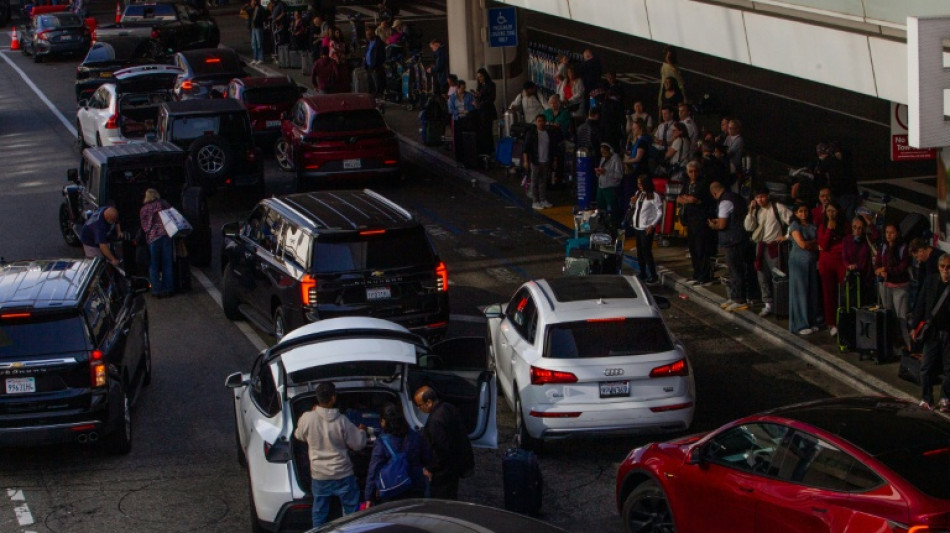
With his wife, their two children, and four suitcases in tow, he steps out into a river of frustrated drivers.
Amid a cacophony of honking horns, the family struggles to identify the shuttle bus that will take them to their rental car.
"There's no signs really saying where I gotta go," says the mining industry employee, who traveled from Perth, Australia. "I did my research, and I'm still struggling."
James, 47, has passed through this airport several times before, and feels sorry for foreign visitors.
"I'm still lost, and I'm an American," he tells AFP. "This is really annoying."
The infuriating design of LAX -- the main airport in America's second biggest city -- is almost legendary.
About 95,000 vehicles pass through the airport daily, most of which funnel into a bottleneck: a horseshoe-shaped roadway looping past all the terminals, where every passenger tries to get dropped off or picked up as close to the entrance as possible.
In an effort to alleviate congestion, taxis and ride-share services are prohibited from picking up passengers along this main thoroughfare.
- Unfinished train -
To make their way out of the airport, arriving passengers who don't have friends or family coming must take shuttle buses, which all look alike, yet travel to different destinations depending on the color of their designated stop: green for the taxi lot, purple for car rentals, red for certain hotels, pink for other terminals.
"LAX airport is definitely an airport that people in Los Angeles love to hate," says Joshua Schank, a public policy specialist at the University of California, Los Angeles (UCLA).
Next month's World Cup, where Los Angeles is hosting eight matches, was supposed to allow the Californian metropolis to burnish its image, just two years before the city hosts the Olympic Games.
To help ease blockages at the airport, an "automated people mover" train connecting it to the city's sparse subway system was scheduled to go into service in 2023.
But the $3.5 billion project has become bogged down in delays and contractural disputes, and remains in the testing phase.
People arriving at the airport now can watch as the empty trains shuttle impotently back and forth.
They will not be ready in time for World Cup fans, and authorities are no longer providing a start date. LAX managers declined AFP requests for an interview.
This train "has not received the kind of attention that it really deserves in terms of urgency from elected leaders," sighs Schank.
- 'Hell' -
It's not just at the airport that the transport network is creaky.
As a place that came of age with the automobile, Los Angeles is a sprawl of freeways with a public transport system that would embarrass any medium-sized European city.
Buses are infrequent and haphazard, while the subway has only six trundling lines radiating out from the centre, making connections impossible without going all the way in and then all the way out again.
The roads are often pockmarked with potholes, further slowing down the millions of tightly-packed cars, with 5-mile (8-kilometer) commute easily taking 45 minutes.
City managers, eager to ease the headaches for fans flocking to the stadium in Inglewood, have said they will deploy 300 buses running to the games from a dozen different locations, including the airport.
The fare will remain the LA-standard $1.75 -- a small victory for fans smarting at the $98 price tag for a round-trip train ticket between New York and MetLife Stadium.
Fixing the city's transport mess is a long-term project, says Schank, but making it easier to get to and from the airport is a must.
The people mover, once operational, is only one part of the equation.
"You have to have good mass transit connections to that people mover if you want people to use mass transit," he said, noting the metro station where it terminates doesn't even take you to downtown LA.
"What's needed are policy changes, adding new mass transit options," he says. "Elected leaders need to step up... if we're going to have a successful Olympics."
Until then, Nigerian Henrietta Henry, who describes her first ever visit to LAX as "hell," has one piece of advice for fans this summer: "Do your homework."
J.F.Rauw--JdB