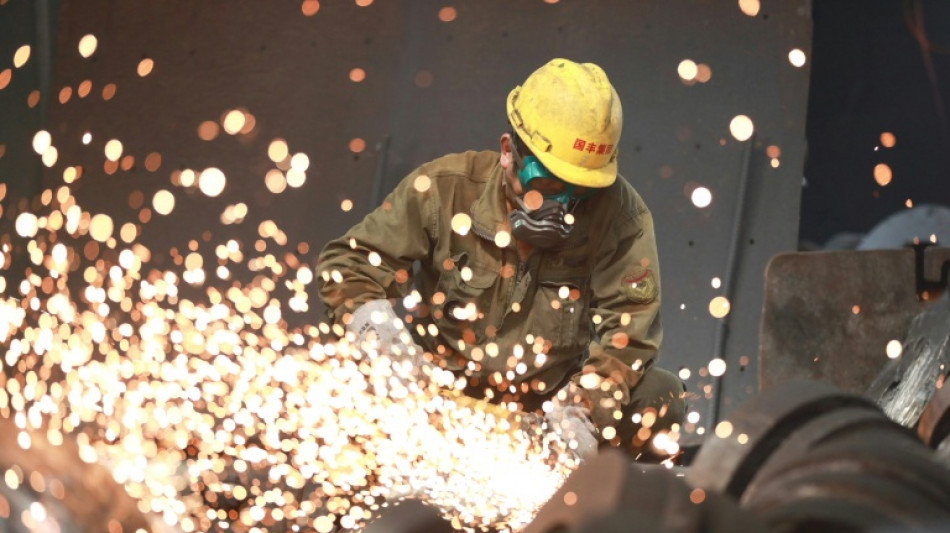
US firms voice 'concern' over China's new supply chain rules / Photo: - - CN-STR/AFP
China's new supply chain regulations could be a "concern" for US firms, the American Chamber of Commerce in China warned on Thursday.
The regulations, released on April 7, allow Chinese authorities to take measures against foreign companies or individuals that "harm China's industrial and supply chain security".
The rules appeared aimed at stopping companies from removing China from their supply chains, AmCham China's president Michael Hart said on Thursday.
Western governments are increasingly concerned about their reliance on Chinese supply chains, particularly in rare earths, which China dominates.
The minerals are critical for a wide range of products from everyday consumer electronics to weapons, and Chinese export curbs during a blistering trade war with the United States last year sent shockwaves across industries.
"There's a little bit of irony as China continues to build up its own supply chain to make sure it's not reliant on others," Hart told a news conference launching his group's annual report on American business in China.
Most US companies are not moving manufacturing out of China, he said, but some were looking to diversify, and if the new rules restrict those moves, it would be a "concern".
- 'Increased risks' -
The European Union Chamber of Commerce in China (EUCCC) criticised the provisions as "unclear and vague" earlier this month, saying their implementation "increases the risk of doing business in or with China".
They "leave open the possibility that several legitimate commercial decisions" could be construed as threatening China's supply chains, it said.
"The threat that individual employees could be punished through exit bans is concerning," the EUCCC added.
Hart said more clarity on the rules' implementation was needed.
China accounts for around 90 percent of global production of rare earths, and the elements are expected to be a key talking point at a summit between US President Donald Trump and his Chinese counterpart Xi Jinping, scheduled for mid-May.
They could reach agreements on aviation, agriculture and food export restrictions, but major diplomatic or economic deals are unlikely, AmCham China's chairman James Zimmerman said Thursday.
"We are not anticipating any grand bargains. We're not anticipating any huge breakthroughs," he said.
AmCham China's report showed US firms in China had seen some regulatory improvements and steps towards a more open economy in the last 12 months, but still face uneven market access and structural pressures on competition and investment.
They also worried about weak demand and squeezed profitability, with China's economic slowdown seen as their top challenge, ahead of US-China tensions, according to AmCham China's business survey released in January.
F.Dubois--JdB