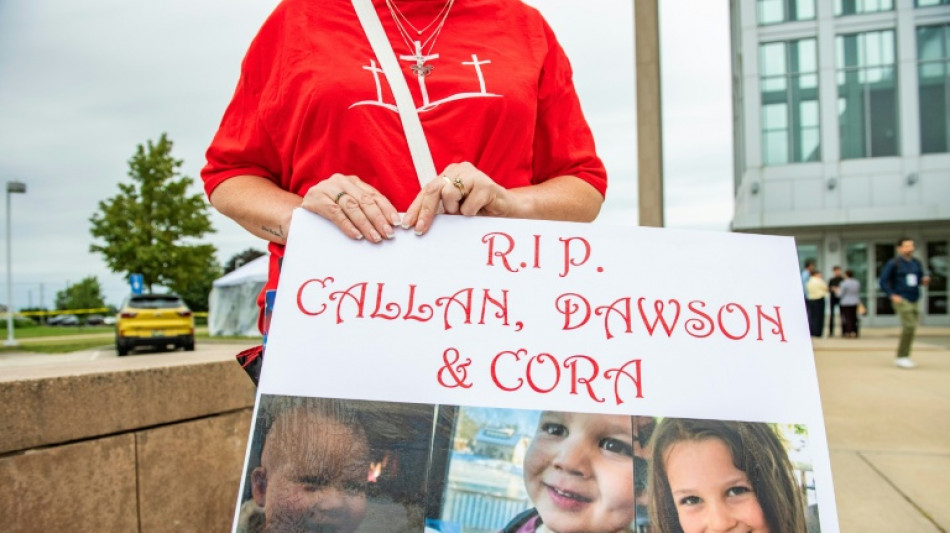
US jury deadlocks again in Lindsay Clancy's child murder trial / Photo: JOSEPH PREZIOSO - AFP
A US judge on Wednesday sent jurors back for a final push toward a verdict in Lindsay Clancy's triple murder trial after they deadlocked for a second time, raising the prospect of a mistrial.
Clancy, 36, does not deny strangling her children Cora, five, Dawson, three, and Callan, eight months, but claims she was suffering from postpartum psychosis -- excusing her from criminal responsibility.
Her five-week trial, which was televised and featured more than 80 witnesses, has sparked debate in the United States over maternal mental health.
The jury on Wednesday indicated to Judge William Sullivan that it had reached a stalemate again on the fifth day of deliberations.
To reach a verdict, all 12 jurors must agree.
If they cannot agree, the judge will declare a mistrial and prosecutors must decide whether to try the case again with a new jury.
According to US media, Sullivan issued the jurors a last-resort, so-called "dynamite charge" that encourages them to keep discussing in a bid to break the impasse and avoid a mistrial.
Clancy has pleaded not guilty by reason of insanity, saying she heard a voice ordering her to kill her children. Her lawyers say this was caused by postpartum psychosis.
After the killings at her family home in Duxbury, Massachusetts, in January 2023, she jumped from a second-story window in an apparent suicide attempt that left her paralyzed from the waist down.
The former nurse faces life in prison without the possibility of parole if found guilty of first-degree murder.
Jurors can also find Clancy guilty of second-degree murder, manslaughter, or not guilty by lack of criminal responsibility -- a verdict that would see Clancy sent to a psychiatric facility.
During Clancy's trial, dozens of women dressed in pink came to the Massachusetts court to show their support for her.
Postpartum psychosis is a medical emergency that affects about one to two women in every 1,000 births, according to Sally Wilson, national training coordinator at the UK-based charity Action on Postpartum Psychosis.
Clancy's case is "an incredibly distressing and rare outcome of postpartum psychosis," Wilson told AFP last month.
D.Mertens--JdB