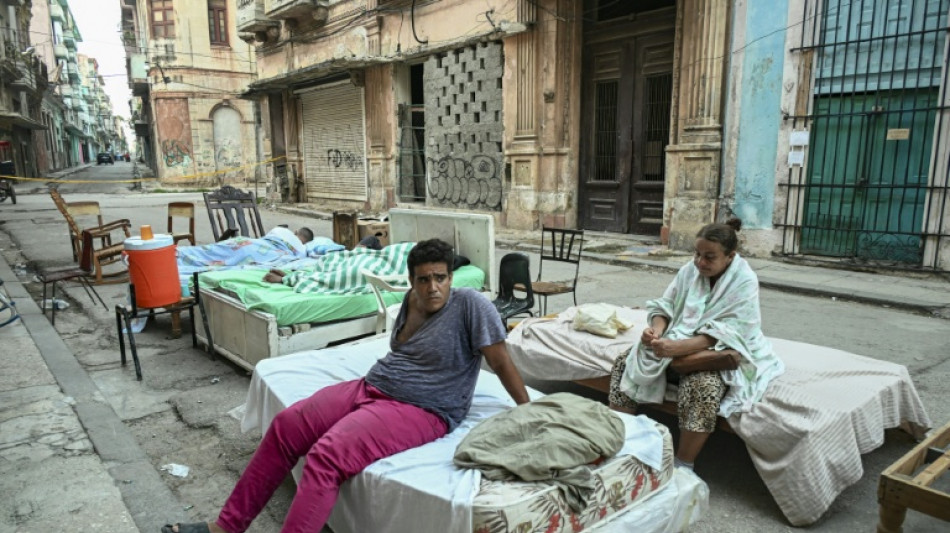
Cuba's famed resilience comes at a growing mental cost / Photo: YAMIL LAGE - AFP
Cubans take pride in facing hardship with resilience and ingenuity, but that fortitude comes at a high psychological cost amid the island's latest protracted crisis.
On a street in Central Havana, Mayumis Nunez wakes up on an improvised bed in front of the building where she lived for years.
Three weeks ago, part of the beautiful century-old structure collapsed, and it was declared uninhabitable. Since then, she has had nowhere else to spend the night.
Sleeping out in the stifling summer heat leaves her exhausted, but what distresses her more is not knowing when or how this situation will end.
"Just imagine not having any rest. Knowing that it's one day, and another day and another day," says the 44-year-old.
Every morning, she wakes up and climbs up to her damaged apartment to bathe, change clothes and get ready for work.
Since Washington launched an energy blockade in January, living conditions have worsened markedly.
Power cuts mean that water pumps grind to a halt. Gasoline shortages mean public buses have disappeared from now-deserted roads.
For millions of Cubans, getting water and food, getting around and even sleeping through the night have become daily challenges.
But beyond the material hardships, many describe a similar feeling: the impossibility of unplugging from their problems.
The constant effort of solving today's problems has left no energy to think about tomorrow.
- 'State of alert' -
At Havana's Calixto Garcia hospital, where a clinic specializing in stress management has operated for years, doctors say the crisis is increasingly reflected in patient visits.
Sitting in a circle, students, retirees and professionals share similar worries: blackouts, economic hardship, relatives who have emigrated and plans put on hold.
Among the participants is 29-year-old teaching student Claudia Sifredo.
Like many young Cubans, she has postponed personal goals, including moving out of her parents' home, a dream she now considers beyond her reach.
"Everything is chaotic," she explains. "This current situation is so stressful and so uncertain that you don't even know how to get through the day."
For now, she says, therapy has helped her focus on what she can control.
"I have to learn how to deal with this environment that I can't change right now."
The concerns may differ from person to person, but many return to the same themes: uncertainty, exhaustion, relatives who have left the country and plans put on hold.
For Tania Peon, director of mental health for the city of Havana, a large part of the population lives in a permanent "state of alert."
"People are constantly focused on meeting basic needs," she explains.
That continuous effort eventually accumulates. "It's stress on top of stress," she says.
According to the specialist, families continue to find ways to cope with shortages, but the wear and tear is becoming increasingly evident.
"The level of exhaustion is high."
The concern is particularly visible among younger people, who are in a stage of life usually associated with building plans and expectations for the future.
"In the first half of this year, we've been observing an increase in suicidal behavior among our teenagers," Peon warns.
While she stresses that this trend cannot be attributed solely to the country's crisis, neither can it be separated from the uncertainty and daily pressures many young people face.
Signs of psychological deterioration were already visible before the latest worsening of the energy crisis.
A survey carried out in 2025 among Cuban adults detected "extremely severe" levels of depression, anxiety and stress and found a direct relationship between prolonged blackouts and worsening mental health.
- A future forestalled -
Leandro Wanton, a 45-year-old tour guide, admits there are days when frustration becomes difficult to contain.
"There are days when you wake up and you just want to explode," he says.
Together with his partner, 49-year-old chef Roberto Ronda, he is trying to keep a small food business going in Old Havana.
The blackouts disrupt schedules, spoil products and make each workday unpredictable.
"There's no peace, no rest," Roberto says. "Your mental health wears down."
The uncertainty also shapes the way he thinks about the future.
"The future for me is uncertain" unless "something happens, a radical change" in the country, he acknowledges.
A two-hour drive west of Havana, in rural Consolacion del Sur, the picture is much the same for farmer Fidel Maqueira, who spends his nights guarding his oxen against theft.
He too copes with blackouts, water shortages, a lack of farming supplies and ever-rising prices.
"We're living through a very bad time. We're going crazy," he says. "We don't have any peace at all".
To keep going, he tries "not to think too much about the problems" and to make do "with the little one has."
As night falls in Havana, Mayumis lies down once again in front of her semi-collapsed building.
Tomorrow she will get up, climb back to what remains of her apartment, prepare for work and once again try to solve the problems of the day.
The next day she will do the same. And the day after that too.
Y.Niessen--JdB