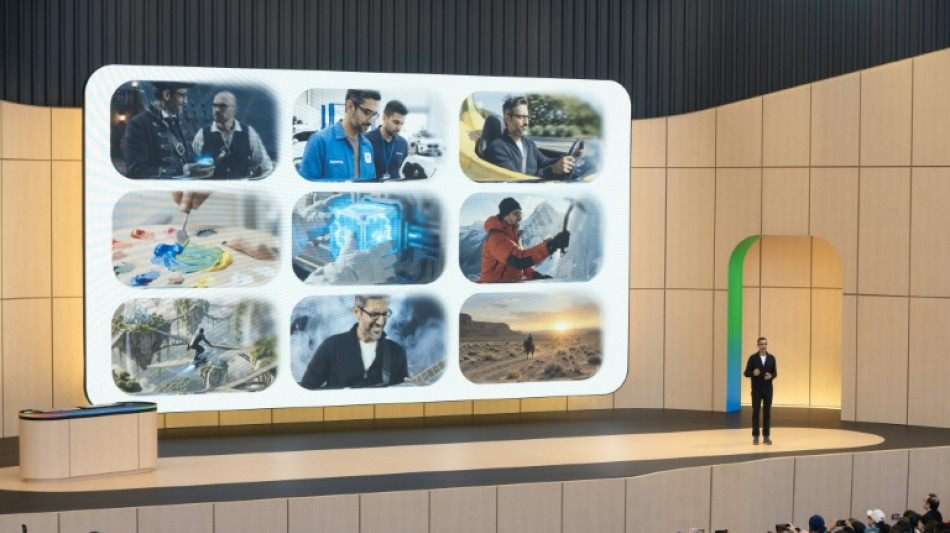
Google wants its search bar to act on your behalf in AI revamp / Photo: Karl Mondon - AFP
Google on Tuesday showed off new plans to turn its famous search bar into an AI assistant that can book restaurants, track news and contact businesses -- just by asking a question.
After three years of struggling to keep up with ChatGPT, Google is racing to roll out artificial intelligence tools that build on its grip over online search.
The company's Gemini AI app now has 900 million monthly users, twice as many as last year. Its AI-powered search feature, AI Mode, is also taking off, with a claimed one billion monthly users worldwide.
On Tuesday, at Google's annual developer conference near its California headquarters in Mountain View, CEO Sundar Pichai unveiled the next step: Gemini Spark, a personal AI agent available starting next week for top-tier subscribers in the United States.
Google's search engine will also get a new upgrade for US users this summer: always-on AI agents that can alert you to news, book activities, and manage shopping lists.
The changes to Google search, which the company said were its biggest in 25 years, will also see a widened search box to make room for more complicated queries people use for chatbots.
"I love how search has become less about individual queries and feels more like an ongoing conversation, giving users deeper insights and connecting you with the vastness of the web," Pichai told journalists.
Many of the features ride a wave of "agentic" AI that has gripped Silicon Valley since Austrian developer Peter Steinberger in late 2025 launched OpenClaw -- a platform that lets AI book flights, manage emails and build apps from chat prompts.
OpenAI hired OpenClaw's creator earlier this year and the tech giants are now racing to bring agentic features to mainstream users, despite security concerns and the soaring computing costs that come with them.
To stay ahead of rivals Anthropic and OpenAI, Google on Tuesday also launched the latest version of its AI model, Gemini 3.5 Flash.
Google says it runs four times faster than top competing models -- including Anthropic's Claude Opus and OpenAI's ChatGPT 5.5 -- while performing at a similar level.
The model is now the default across the Gemini app, AI Mode search and other Google services. A more powerful version, Gemini 3.5 Pro, is expected next month.
Google also announced it was teaming up with OpenAI on one front: to help stop the spread of fake or manipulated content, the ChatGPT maker has adopted SynthID, Google's tool for invisibly watermarking AI-generated images.
- End of clicks? -
Google's growing AI features could spell trouble for news websites and online publishers.
By keeping users inside its own apps and tools, Google makes it less likely that people will click through to outside websites -- cutting into their traffic and ad revenue.
Google searches already end 58 percent of the time without users clicking on any website, according to a lawsuit filed against the company by Penske Media, which publishes the Hollywood Reporter and Rolling Stone.
In Europe, a major publishers' group has complained to the European Commission, saying Google uses news content to fuel its AI summaries without paying for it.
France is the only major European country where AI Mode is still unavailable, and remains at the center of a bitter fight between Google and French publishers.
However, Google's legal troubles are not limited to Europe.
A US court found it guilty of illegally monopolizing online search in 2024, and the company could still be forced to break up parts of its business.
The Justice Department in February appealed a ruling that had stopped short of making Google sell its Chrome browser.
A hearing is not expected until the end of the year at the earliest, or possibly 2027.
H.Raes--JdB