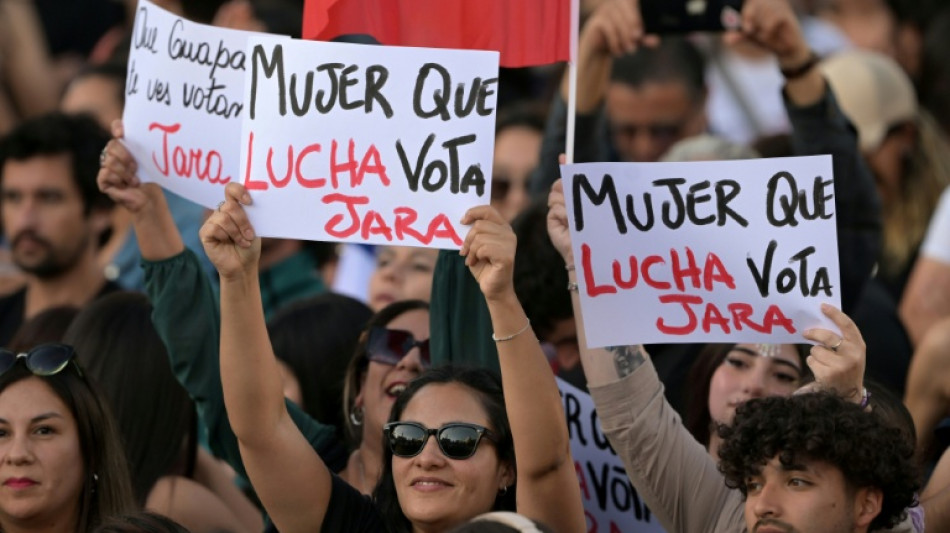
Women's rights seen as under threat as Chile heads to polls / Photo: Rodrigo ARANGUA - AFP/File
The emergence of a hard-right frontrunner in Chile's presidential election on Sunday has left many worried that hard-won women's freedoms could be rolled back.
Chile has long been among Latin America's most conservative countries, with society and policy shaped by a powerful Catholic Church.
Divorce became legal in 2004. A total abortion ban was lifted in 2017.
The country of 20 million will face a stark choice between a communist and an arch-Catholic father of nine, both of whom are vying to lead the country for the next four years.
They are offering strikingly different visions on abortion and gender equality.
Jeannette Jara, a former labor minister backed by a broad left-wing coalition, wants to legalize abortion up to 14 weeks.
Her rival and the frontrunner, Jose Antonio Kast, opposes any liberalization and has long rejected contraception, divorce and same-sex marriage.
Today, abortion is allowed only in cases of rape, risk to the mother's life or fetal inviability.
Even against this conservative backdrop, some are concerned about Kast's intentions.
"Kast doesn't seem to like women," says Claudia Silva, a 63-year-old forced to drive a taxi because she cannot get by on a meager pension.
Yet, she intends to vote for Kast for his promises to tackle violent crime -- which has surged in recent decades.
Minister for Women Antonia Orellana told AFP that gains for women under the leftist government of self-proclaimed feminist Gabriel Boric were now under threat.
She said she was "concerned" about the implementation of new laws to curb violence against women that still require "years of effort and political will."
Javiera Mena, a women's rights activist, warned that under Kast, sexual and reproductive rights and comprehensive sex education were at risk.
Kast, an admirer of former military dictator Augusto Pinochet, opposed abortion, contraception, divorce, and same-sex marriage during his 2021 presidential campaign against Boric.
He also proposed eliminating the Women's Ministry, only to back down.
A member of the conservative Catholic Schoenstatt movement, Kast has run for president twice before and failed.
This time round, he has avoided talking about individual rights, focusing instead on tough measures against crime and immigration.
Asked in November about his opposition to selling emergency contraception in pharmacies, Kast said his convictions remain unchanged: "I'm the same person."
- 'Highly ideological' -
Arturo Squella, president of Kast's Republican Party, has tried to reassure voters, saying changing the current abortion law "is not planned."
Some voters are not buying it. "We've fought for years for women's right to decide over our bodies, sexuality, and reproductive rights," said Isadora Trazar, a 22-year-old student.
"Losing that is dangerous."
"Kast is misogynistic," said 65-year-old construction worker Luis Vergara Carrillo.
"He wants to dictate what's best for women. That's unacceptable today."
Analyst Guillaume Long of the Center for Economic Policy Research calls Kast "highly ideological," and trying to build a "much more patriarchal world."
Still, if elected, Kast will face a fragmented parliament and may struggle to pass hardline reforms.
Carolina Urrego-Sandoval, an international relations expert at the University of the Andes, does not foresee repealing existing laws.
Instead, she predicts changes in rhetoric, funding cuts for women and LGBT initiatives, and setbacks in sex education.
Y.Callens--JdB